Last night I started reading the book Frientimacy* by Shasta Nelson. I first became aware of the book when the Transformation-Cafe podcast chose it for a book club selection last summer; I bought it at that time. My attention was captured in the first chapter. Nelson reports that when she asks audiences, "Do you wish you had more deep and meaningful friendships?" nearly every hand rises. She asked over 12,000 women about their relationships, and over half reported that their friendships weren't very satisfying.
My March 5 blogpost "Warm Fuzzies" revealed that I am in a season of examining the state of my own friendships. It should not be surprising then that Frientimacy, which has been on my nightstand for three-quarters of a year, should "suddenly" grab my attention.
I've written previously about the Buddhist concept that "When the student is ready, the teacher will appear." This week has been rich with opportunities to examine the state of my friendships. I have to say that for at least the last two or three years, if I had been in Nelson's audience, my hand would have registered affirmatively when asked about wanting deeper and more meaningful friendships. For a long time, I accepted responsibility. A definite clue to the problem was that I needed to schedule lunches with friends months in advance.
Then I started making time, and I found that some people were still not available, yet others would leap tall buildings to make sure we could get together. This week I spent really rich time with two friends. At the end of each, I felt even closer. In the same period of time one person that I've considered a close friend avoided responding to an email, and another said she could make time in the 3rd Quarter, as if she were scheduling me in her business plan.
After several weeks away from my Spanish lessons, I started listening again today as I walked my errands on a gorgeous spring day. Many/most latin languages make a distinction in grammar in the form of a verb that is used to address a close friend as opposed to the verb that is used for an acquaintance. I kept stumbling on the distinction as I practiced responding to prompts during my lessons. When I was supposed to be replying to a close friend, I'd use the form for an acquaintance.
About an hour into the lessons, it occurred to me that this may be what is going on in my life...except in reverse. I want "close friends," but I've been addressing those who want to be responded to as "acquaintances." Suddenly it came to me that these are twice-a-year, thin-coating-of-friendship people required the formal version of the verb. I say this while fully recognizing that that my comfort level with relationships may often have been varying layers of veneer. Unknowingly, I may have teed these relationships up with that expectation.
I really value those that I had good times with in a veneer sort of way. But that's just not sufficient for me anymore. I want the deep and meaningful friendships of which Nelson writes. As the title of the book suggests, intimacy is the vessel through which we have those relationships.
Over 20 years ago, my understanding of intimacy was profoundly shaped by my author friend Mark Youngblood in his book Life at the Edge of Chaos. He describes "intimacy" as "in-to-me-see." I spent several days in meditation around this concept after reading it. I recognized the barriers I put up to people seeing into my heart. I ached for days.
While I craved intimacy, I recognized that I had at least two problems with it. First, connected silence is essential. Walk to the edge of something really uncomfortable and take a deep breath--kind of like jumping off the high dive. Except in friendship, we walk to the edge, take a deep breath, and dive together. There is a level of tension that comes with just sitting with someone while they work up courage to metaphorically jump. While I think I am very good with this my profession, I am lousy at it in my personal life. Changing the subject has been my habit more often than I'd like to admit.
The second challenge that I have had is with the people I attract into my life. Like a homing pigeon, I can find the people who will be incapable of intimacy with uncanny accuracy. Clearly, I have begun to shift that trend, as witnessed by those intimate conversations I've had recently. If they can't go there, then I have been able to say that I want the intimacy, and I can still be rescued from the responsibility required to create it.
This is about love--the kind of divine love that I've written about at length...what connects us all. We can't get there until we drop the barriers and let others see into our hearts and souls. In one of the best-selling books of all time--The Road Less Traveled--author M. Scott Peck actually describes love as "The will to extend one's self for the purpose of nurturing one's own or another's spiritual growth."
In that definition I believe that he has described intimate friendship. I see into my own heart. I see into the heart of my friend. I let my friends see into me. We jump together. We both grow. Love grows between us and in the Universe as well. Perhaps the reason so many of us crave it so is that the world needs. I started to write that I couldn't do superficial any more, but the truth is that I can: I am just unwilling. I am setting for the power of my intention to attract more intimate relationships for the rest of my life AND to have the courage to step into them.
In the richness of my exploration, perhaps what I am finding is me.
*Frientimacy by Shasta Nelson, Seal Press, 2016.
*Life at the Edge of Chaos, Mark Youngblood, Perceval Publishing, 1997.
*The Road Less Traveled, M. Scott Peck, M.D., Touchstone/Simon & Schuster, 1978.
Showing posts with label spiritual learning. Show all posts
Showing posts with label spiritual learning. Show all posts
Thursday, March 9, 2017

Wednesday, March 8, 2017
Dating Two Men at Once
I recently discovered a fun, easy podcast, called "Happier," hosted by author Gretchen Rubin and her sister, screenwriter Elizabeth Craft. The focus of the show is sharing pretty much random thoughts or practices about how to be happier in life. Subscribers get a mid-week "booster shot," which is a single, simple thought that is usually less than two minutes between the regular 80-minute programs.
This week the thought was "Dating Two Men at Once." In it Gretchen harkens back to college days when a friend gave her the advice to always date two men at once. Why? When things aren't going so well with one, they may be with the other. If things don't work out with one, then you aren't alone. If a woman is dating only one man, then it's either win or lose, and we always seem to be trying to figure out are we winning or losing at this moment. Dating two? You've got win, lose, pivot.
Now, this should not be an earth-shaking idea: it is just a bit of a twist on the Buddhist concept of non-attachment.
There is a story set in "olden times," about a Chinese farmer. His horse ran away at planting time. "Oh, how terrible for you," his neighbors said, "you will not be able to plant your crops."
"Maybe yes. Maybe no. We never know."
The next day his horse came back, bringing a wild stallion with her. "Oh, how lucky for you, " his neighbors said, "to have two horses is a great fortune."
"Maybe yes. Maybe no. We never know."
The next day his son was trying to break the stallion, which reared up and came down on him, breaking his leg. "Oh, how terrible for you, " his neighbors said, "your son will not be able to help you with the planting and tending your crops."
"Maybe yes. Maybe no. We never know."
A few days later the army came through the farmer's village, conscripting all of the able-bodied men to fight in the war. Because his son had a broken leg, he was not taken. "Oh, how fortunate for you that your son doesn't have to go to war."
"Enough!!" said the farmer. "Always you must judge. We never know what will be good and what will be bad.
Whenever we "date one man," we tend to fall into the habit of looking at situations, behaviors, and habits as either good or bad. Rather than taking the advice of the farmer and being open about what they will mean.
Obviously, this thought from two married women is about way more than dating. It is about holding the potential of a range of possibilities, withholding judgment and staying open and flexible.
I had a great conversation yesterday with a friend, who is action-oriented, about my transition. "I am just not ready!" I said several times during the conversation as she made suggestions to get me moving. I am not ready to know whether my future is in health coaching or working with refugees or some other possibility that I haven't considered. I am sort of "dating" different options. Who knows? Maybe I will decide to hang out with both indefinitely.
I have always had the concept of a "job" as a single thing that I would do which pretty much takes all my weekday time and is the source of my income, whether I do it for an employer or work for myself. "Dating two..." offers the possibility that I might dabble at both...and maybe more things, generating income from all of them. I like it.
Another application of this "happier" idea is that I've thought I had to "get through" this transition as soon as possible--to some as-yet-unknown destination where I would work for the duration of my career. I am now holding the possibility that my transition may be longer, maybe much longer. If I am "not ready," my heart is telling me to linger longer in the exploration. Although I have bristled when people have thought I was ending my career instead of being in an "exploration," the possibility of just allowing the exploration to take as long as it takes is not something I have considered before.
"Dating two men at once," it would seem, is a very liberating concept and one which brought me considerably less tension as I am now in my 11th week of transition. One might even say that it has made me "happier."
This week the thought was "Dating Two Men at Once." In it Gretchen harkens back to college days when a friend gave her the advice to always date two men at once. Why? When things aren't going so well with one, they may be with the other. If things don't work out with one, then you aren't alone. If a woman is dating only one man, then it's either win or lose, and we always seem to be trying to figure out are we winning or losing at this moment. Dating two? You've got win, lose, pivot.
Now, this should not be an earth-shaking idea: it is just a bit of a twist on the Buddhist concept of non-attachment.
There is a story set in "olden times," about a Chinese farmer. His horse ran away at planting time. "Oh, how terrible for you," his neighbors said, "you will not be able to plant your crops."
"Maybe yes. Maybe no. We never know."
The next day his horse came back, bringing a wild stallion with her. "Oh, how lucky for you, " his neighbors said, "to have two horses is a great fortune."
"Maybe yes. Maybe no. We never know."
The next day his son was trying to break the stallion, which reared up and came down on him, breaking his leg. "Oh, how terrible for you, " his neighbors said, "your son will not be able to help you with the planting and tending your crops."
"Maybe yes. Maybe no. We never know."
A few days later the army came through the farmer's village, conscripting all of the able-bodied men to fight in the war. Because his son had a broken leg, he was not taken. "Oh, how fortunate for you that your son doesn't have to go to war."
"Enough!!" said the farmer. "Always you must judge. We never know what will be good and what will be bad.
Whenever we "date one man," we tend to fall into the habit of looking at situations, behaviors, and habits as either good or bad. Rather than taking the advice of the farmer and being open about what they will mean.
Obviously, this thought from two married women is about way more than dating. It is about holding the potential of a range of possibilities, withholding judgment and staying open and flexible.
I had a great conversation yesterday with a friend, who is action-oriented, about my transition. "I am just not ready!" I said several times during the conversation as she made suggestions to get me moving. I am not ready to know whether my future is in health coaching or working with refugees or some other possibility that I haven't considered. I am sort of "dating" different options. Who knows? Maybe I will decide to hang out with both indefinitely.
I have always had the concept of a "job" as a single thing that I would do which pretty much takes all my weekday time and is the source of my income, whether I do it for an employer or work for myself. "Dating two..." offers the possibility that I might dabble at both...and maybe more things, generating income from all of them. I like it.
Another application of this "happier" idea is that I've thought I had to "get through" this transition as soon as possible--to some as-yet-unknown destination where I would work for the duration of my career. I am now holding the possibility that my transition may be longer, maybe much longer. If I am "not ready," my heart is telling me to linger longer in the exploration. Although I have bristled when people have thought I was ending my career instead of being in an "exploration," the possibility of just allowing the exploration to take as long as it takes is not something I have considered before.
"Dating two men at once," it would seem, is a very liberating concept and one which brought me considerably less tension as I am now in my 11th week of transition. One might even say that it has made me "happier."
Friday, March 3, 2017
Allow Yourself to Fail
As I carried a box of office accumulation from my office on one of my last days of work, I ran into a colleague who didn't realize that I was making my exit from the organization. I told her I was entering a transition period during which I would explore new career options. She, and a number of others before her, remarked how courageous it was of me to leave my current position before having a new one in hand. I didn't think it courageous at all. To continue to be bored with my work seemed among the worst option that I faced; I just didn't want to do that any more.
As she and I continued to talk, I related five or six areas of interest that had been sparked in me. I said I wanted to explore each of them in some way until I found a place where I wanted to land for a while. I would try it out, and, if I enjoyed it and felt like I was making a contribution, I would continue. If I didn't enjoy it, I hadn't lost anything, except maybe a few weeks or months. I would move to another option on my list. I was quite excited about the menu of options before me. And, I was excited by the adventure of trying new things.
When both health coaching and refugee involvement--both items on my list--bombarded me with opportunities in early January, I was excited. I truly enjoyed being in learning mode with both. I truly felt fully alive. Then I finished the class about 10 days ago. As a bonus for completion, the organization offered us a significant discount on a number of items, including additional classes, that would help establish our health coaching practices...when purchased within two weeks of the completion of the first course.
I've been to the site a few times. I've stewed a lot. Is this really what I want to do? What about all those other things on my list that I haven't had the opportunity to explore yet? Do I want to abandon the executive, life, and spiritual coaching, which have been the foci of my work over 25 years, or do I want health coaching to be one more offering? This hadn't been unhealthy or obsessive overthinking, and often not even conscious questioning, but more like a soundtrack to my daily life.
Since I have decided to do more focused self-exploration during the 40-day Lenten season, I decided to start the process by drawing a "transformation" card* to focus my meditation. "Allow Yourself to Fail," it read. Among other admonitions, it continued, "Redefine 'failure' as 'steps toward progress'--a means of learning."*
I am rarely concerned about making mistakes, and I often joke that I prefer to work in pencil instead of pen because it allows me to fix mistakes more easily. However, I realized that in regard to this transition that I'd allowed myself to fall into the trap of limiting my options. I recalled the conversation I related above and wondered where I had let my sense of exploratory adventure go. All of a sudden, I had narrowed myself to a "Is it a yes or is it a no?" with regard to a health coaching practice.
Ah! I don't need to do that: additional meaning for "Allow Yourself to Fail." I have a graduate degree in management, and my marketing machine is a well-oiled one. When I started my consulting business in the early 1990s, the editor of the local business journal called me. He wanted to do an article about my marketing because he said everywhere he'd turned in the last two months, he'd hear something about me or read something about me. I know how to do that...well.
What I don't know how to do so well is not market, not have cards and brochures, not have a business plan--all the things that people do to keep their businesses from failing. You've got to be fully in--fully committed to your success all the books say. But I was more interested in sticking my toe in the water to check the temperature rather than jumping off the high dive. To "Allow Yourself to Fail" doesn't mean that I have to fail: it just means that I am willing to give myself that possibility.
Which is exactly where I was when I ran into the colleague when I was moving out of my office in December. "If it doesn't work, what did I lose?" I will now allow myself to shake free of all that Graduate School of Management programming and stick my toe in several pools of water before deciding where to dive in.
I recognize this pattern other places in my life. Something from outside of me pressures me to make a decision--a commitment--to something before I am really ready. Then I figure out how to "do it right," which inevitably puts me on a course from which it is difficult to deviate. Before I know it, I am years into something I didn't want to be doing. This time I really want to shop carefully. I want to make a decision that is correct for me, not because of external pressure...and then I want to allow myself to fail.
*www.ToolkitForTransformation.com
As she and I continued to talk, I related five or six areas of interest that had been sparked in me. I said I wanted to explore each of them in some way until I found a place where I wanted to land for a while. I would try it out, and, if I enjoyed it and felt like I was making a contribution, I would continue. If I didn't enjoy it, I hadn't lost anything, except maybe a few weeks or months. I would move to another option on my list. I was quite excited about the menu of options before me. And, I was excited by the adventure of trying new things.
When both health coaching and refugee involvement--both items on my list--bombarded me with opportunities in early January, I was excited. I truly enjoyed being in learning mode with both. I truly felt fully alive. Then I finished the class about 10 days ago. As a bonus for completion, the organization offered us a significant discount on a number of items, including additional classes, that would help establish our health coaching practices...when purchased within two weeks of the completion of the first course.
I've been to the site a few times. I've stewed a lot. Is this really what I want to do? What about all those other things on my list that I haven't had the opportunity to explore yet? Do I want to abandon the executive, life, and spiritual coaching, which have been the foci of my work over 25 years, or do I want health coaching to be one more offering? This hadn't been unhealthy or obsessive overthinking, and often not even conscious questioning, but more like a soundtrack to my daily life.
Since I have decided to do more focused self-exploration during the 40-day Lenten season, I decided to start the process by drawing a "transformation" card* to focus my meditation. "Allow Yourself to Fail," it read. Among other admonitions, it continued, "Redefine 'failure' as 'steps toward progress'--a means of learning."*
I am rarely concerned about making mistakes, and I often joke that I prefer to work in pencil instead of pen because it allows me to fix mistakes more easily. However, I realized that in regard to this transition that I'd allowed myself to fall into the trap of limiting my options. I recalled the conversation I related above and wondered where I had let my sense of exploratory adventure go. All of a sudden, I had narrowed myself to a "Is it a yes or is it a no?" with regard to a health coaching practice.
Ah! I don't need to do that: additional meaning for "Allow Yourself to Fail." I have a graduate degree in management, and my marketing machine is a well-oiled one. When I started my consulting business in the early 1990s, the editor of the local business journal called me. He wanted to do an article about my marketing because he said everywhere he'd turned in the last two months, he'd hear something about me or read something about me. I know how to do that...well.
What I don't know how to do so well is not market, not have cards and brochures, not have a business plan--all the things that people do to keep their businesses from failing. You've got to be fully in--fully committed to your success all the books say. But I was more interested in sticking my toe in the water to check the temperature rather than jumping off the high dive. To "Allow Yourself to Fail" doesn't mean that I have to fail: it just means that I am willing to give myself that possibility.
Which is exactly where I was when I ran into the colleague when I was moving out of my office in December. "If it doesn't work, what did I lose?" I will now allow myself to shake free of all that Graduate School of Management programming and stick my toe in several pools of water before deciding where to dive in.
I recognize this pattern other places in my life. Something from outside of me pressures me to make a decision--a commitment--to something before I am really ready. Then I figure out how to "do it right," which inevitably puts me on a course from which it is difficult to deviate. Before I know it, I am years into something I didn't want to be doing. This time I really want to shop carefully. I want to make a decision that is correct for me, not because of external pressure...and then I want to allow myself to fail.
*www.ToolkitForTransformation.com
Wednesday, March 1, 2017
Forty Days
Although it feels like light years, it has just been a year ago since I marched into my boss's office and told him I couldn't do that job any longer. I handed him a copy of this cover of Family Practice Management, the journal of the American Academy of Family Physicians. The mostly black and white cover shows the remains of a forest after a fire, only charred twigs of trees sticking up through lingering smoke and clouds. In the foreground is a single daisy, sticking its blossom up through the ashes.
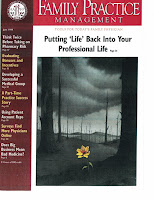
This journal cover was designed to accompany one of two cover articles the Dr. John-Henry Pfifferling and I coauthored in the late 1990s about burn-out and compassion fatigue, a concern that we encountered with physicians we met in our work together at the Center for Professional Well-being. In the cover article, John-Henry and I said that it took six months to recover from long-term burnout. We knew, and more importantly I knew, that there were no short-cuts. I desperately needed that six months to recover.
I assured my boss that I would put in the five months that I expected it would take to complete open projects and leave my clients in a good place, but I just couldn't do it any more. I explained that this picture reflected how I felt after giving too much for too long. I needed time to nurture the little ray of color left in my life.
Yet, even though I knew it would take six months, when the end of my extended notice arrived, I immediately took another job. I gave myself many reasons why I was ready to go to a different job. They were all lies that I told myself because it was a good opportunity. I knew I needed the time to heal. A few months later when I finally admitted that I needed the time, it was an admission of something I'd known all along: I needed to heal.
In some recent posts, I've bragged that I'd knocked a lot off of my "to-do list," lamented that I hadn't discovered my new purpose, and complained that I had a hard time hitting the ground running like I used to. These are all signs that I haven't been adequately healing from my burn-out. As I crawled into bed last night after yesterday's post, the image of this journal cover occurred to me. About the same time, I recalled that today would be Ash Wednesday, which marks the beginning of the 40-day Lenten season, a time of intense spiritual reflection and fasting leading up to Easter.
Although the 40-day Lenten season coincides with the 40 days that Jesus spent praying and fasting just before his crucifixion, that number is probably not happenstance. Since almost the beginning of time, 40 has been a spiritual number which symbolizes "time needed to totally recharge, renew the body; change to a higher perception."* Moses was on Mt. Sinai for 40 days before returning with the Ten Commandments, and he led the Israelites for 40 years before he acknowledged that they had the understanding of God that they needed. Rain fell on the earth for 40 days and nights, creating the flood from which Noah saved the animals in his ark. It occurred to me that the seven weeks of vacation that I had accrued and was going to use to "cover" my recovery was just a hair over the 40 days.
Since I had really given myself less than a week to recover from burnout before charging into a new class and book and cupboard cleaning, I think I need a restart, and what better time than this designated period of Lenten reflection? I didn't worry about when I woke up this morning. I went to church. I spent the afternoon reading a book I wanted to read and plan to go back to it when I finish here. I didn't even turn my computer on until almost 10 tonight, and that was to write this blogpost. (I did make one quick email check on my iPhone on the way to church this morning, and then I closed the mail app.) I turned the news on this morning, and just as quickly turned it off. I spent time in the kitchen, trying a new recipe.
I don't know what this 40 days will bring. I think that is the point. I am going to make every effort to stay out of my head, avoiding all but the very essentials of anything that smacks of planning and productivity. My 40 days will not be the six months that I know I need to heal from burn-out, but, with God's help, at the end of the 40 days, I will know what I need to do next. I think that is all I need to do. Be as present as I can be and allow myself to be led. Ah, that quintessential spiritual lesson...again!
*Bethards, Betty, The Dream Book--Symbols for Self-Understanding, Element, 1983, 1995, P. 140.

This journal cover was designed to accompany one of two cover articles the Dr. John-Henry Pfifferling and I coauthored in the late 1990s about burn-out and compassion fatigue, a concern that we encountered with physicians we met in our work together at the Center for Professional Well-being. In the cover article, John-Henry and I said that it took six months to recover from long-term burnout. We knew, and more importantly I knew, that there were no short-cuts. I desperately needed that six months to recover.
I assured my boss that I would put in the five months that I expected it would take to complete open projects and leave my clients in a good place, but I just couldn't do it any more. I explained that this picture reflected how I felt after giving too much for too long. I needed time to nurture the little ray of color left in my life.
Yet, even though I knew it would take six months, when the end of my extended notice arrived, I immediately took another job. I gave myself many reasons why I was ready to go to a different job. They were all lies that I told myself because it was a good opportunity. I knew I needed the time to heal. A few months later when I finally admitted that I needed the time, it was an admission of something I'd known all along: I needed to heal.
In some recent posts, I've bragged that I'd knocked a lot off of my "to-do list," lamented that I hadn't discovered my new purpose, and complained that I had a hard time hitting the ground running like I used to. These are all signs that I haven't been adequately healing from my burn-out. As I crawled into bed last night after yesterday's post, the image of this journal cover occurred to me. About the same time, I recalled that today would be Ash Wednesday, which marks the beginning of the 40-day Lenten season, a time of intense spiritual reflection and fasting leading up to Easter.
Although the 40-day Lenten season coincides with the 40 days that Jesus spent praying and fasting just before his crucifixion, that number is probably not happenstance. Since almost the beginning of time, 40 has been a spiritual number which symbolizes "time needed to totally recharge, renew the body; change to a higher perception."* Moses was on Mt. Sinai for 40 days before returning with the Ten Commandments, and he led the Israelites for 40 years before he acknowledged that they had the understanding of God that they needed. Rain fell on the earth for 40 days and nights, creating the flood from which Noah saved the animals in his ark. It occurred to me that the seven weeks of vacation that I had accrued and was going to use to "cover" my recovery was just a hair over the 40 days.
Since I had really given myself less than a week to recover from burnout before charging into a new class and book and cupboard cleaning, I think I need a restart, and what better time than this designated period of Lenten reflection? I didn't worry about when I woke up this morning. I went to church. I spent the afternoon reading a book I wanted to read and plan to go back to it when I finish here. I didn't even turn my computer on until almost 10 tonight, and that was to write this blogpost. (I did make one quick email check on my iPhone on the way to church this morning, and then I closed the mail app.) I turned the news on this morning, and just as quickly turned it off. I spent time in the kitchen, trying a new recipe.
I don't know what this 40 days will bring. I think that is the point. I am going to make every effort to stay out of my head, avoiding all but the very essentials of anything that smacks of planning and productivity. My 40 days will not be the six months that I know I need to heal from burn-out, but, with God's help, at the end of the 40 days, I will know what I need to do next. I think that is all I need to do. Be as present as I can be and allow myself to be led. Ah, that quintessential spiritual lesson...again!
*Bethards, Betty, The Dream Book--Symbols for Self-Understanding, Element, 1983, 1995, P. 140.
Tuesday, February 28, 2017
What Gets Me Up in the Morning?
I've been writing about thoughts I've had while reading Blue Zones--9 Lessons for Living Longer from the people who've lived the longest. The last of the characteristics which centenarians in "blue zones"--those regions that have a disproportionate number of individuals who live to be over 100--shared across the globe was a "sense of purpose." I particularly liked the Okinawan's embrace of "ikigai"--the reason they get up in the morning.
While I've always felt like we have a reason that we are in the world, and I've also thought that it evolves over our lives, I've generally had the mental model of life purpose as a major contribution to the world. However, in the blue zones the reason that gets people up in the morning is a focus of activity that individuals take with them through life. For one, it is maintaining his ability to do certain physical exercises. For another, it is hiking to the top of a ridge he has scaled every day for 80 years to see the spectacular view. For still another, it is caring for her grandchildren, great-grandchildren, and sheer delight in holding her first great-great-grandchild.
Whatever it is for each of these, it is something that gets them out of bed in the morning.
I've actually been struggling with getting up in the morning during my transition period. Not in a depressed way. After a lifetime of bouncing up and hitting the day running, as the old commercial used to say, "My get-up-and-go got up and went." I have shifted to a night-owl schedule which is more natural to me. And, I really wanted not to have to b aroused by an alarm ever again. I used to wake after 7-1/2 or 8 hours of sleep, even without the alarm, so why should I need it? At first, when I slept long, I thought it was years of exhaustion accumulated and demanding rest.
Once I am up and moving, I can focus from activity to activity, and I get a reasonable amount accomplished. I've been ticking things off my to-do list, and I am pleased to say that a long Outlook task list was completed today. I've taken a number of webinars and am reading several books in parallel. When I start moving, I have plenty of focus and energy.
It's just getting started. About a week ago, I even started setting the alarm again, but except on the day when I had to report for surgery, I've shut it off and gone back to sleep. Then I read about ikigai. While I have lots to keep me busy once I am awake, I don't feel like I have a reason that compels me to get up in the morning. In large part, that is what this transition is about--finding that new purpose. But perhaps I've been aiming too high. Maybe my purpose could be as simple as living the best life to carry me to 100 or writing in this blog every day, even though there are many days when no one reads it.
What, I've been asking myself, will make me want to bound from bed the way serving my clients did when I had a regular job? (And when that was gone, it told me that it was time to find something different to focus on in my life.) I'm not there yet, but having the question will allow me to play around with some options when the alarm goes off in the morning.
While I've always felt like we have a reason that we are in the world, and I've also thought that it evolves over our lives, I've generally had the mental model of life purpose as a major contribution to the world. However, in the blue zones the reason that gets people up in the morning is a focus of activity that individuals take with them through life. For one, it is maintaining his ability to do certain physical exercises. For another, it is hiking to the top of a ridge he has scaled every day for 80 years to see the spectacular view. For still another, it is caring for her grandchildren, great-grandchildren, and sheer delight in holding her first great-great-grandchild.
Whatever it is for each of these, it is something that gets them out of bed in the morning.
I've actually been struggling with getting up in the morning during my transition period. Not in a depressed way. After a lifetime of bouncing up and hitting the day running, as the old commercial used to say, "My get-up-and-go got up and went." I have shifted to a night-owl schedule which is more natural to me. And, I really wanted not to have to b aroused by an alarm ever again. I used to wake after 7-1/2 or 8 hours of sleep, even without the alarm, so why should I need it? At first, when I slept long, I thought it was years of exhaustion accumulated and demanding rest.
Once I am up and moving, I can focus from activity to activity, and I get a reasonable amount accomplished. I've been ticking things off my to-do list, and I am pleased to say that a long Outlook task list was completed today. I've taken a number of webinars and am reading several books in parallel. When I start moving, I have plenty of focus and energy.
It's just getting started. About a week ago, I even started setting the alarm again, but except on the day when I had to report for surgery, I've shut it off and gone back to sleep. Then I read about ikigai. While I have lots to keep me busy once I am awake, I don't feel like I have a reason that compels me to get up in the morning. In large part, that is what this transition is about--finding that new purpose. But perhaps I've been aiming too high. Maybe my purpose could be as simple as living the best life to carry me to 100 or writing in this blog every day, even though there are many days when no one reads it.
What, I've been asking myself, will make me want to bound from bed the way serving my clients did when I had a regular job? (And when that was gone, it told me that it was time to find something different to focus on in my life.) I'm not there yet, but having the question will allow me to play around with some options when the alarm goes off in the morning.
Monday, February 27, 2017
Who's in Charge?
I finished reading Blue Zones--9 Lessons for Living Longer from the people who've lived the longest last night. It has left me pondering two questions. I will explore one today, and I'll save the other for tomorrow's post. I'd like to start with "locus of control." The textbook that I used to teach organizational behavior defines "locus of control" as "the degree to which people believe they are masters of their own fate."*
What the textbook says, and what I taught, is that if a person believes their success is internally driven, called "internal," they are more highly motivated and willing to take action to make things happen in their lives. They generally perform better on the job, demonstrating their belief that they are the ones that influence career success. Internals believe their health is largely in their hands, and they take steps to stay healthy. Consequently, they have lower rates of absenteeism.
By contrast, "externals" believe that some force outside of themselves determines their fate. In that case, they are not inclined to take steps to advance their careers or their lives. Why would they, since they don't believe that anything they do, for good or not, can change the course of their lives? They generally aren't engaged in their work and are less satisfied in their career and life in general.
Many externals believe that God or some other outside force is piloting the ship of their destiny, but many internals attribute God's desire for us to experience abundance to the reason they are in charge of their destiny. Prosperity gospel churches and Mastermind groups are examples of the latter group.
The uncomfortable juxtaposition of these ideas has been on my heart for decades. I am all about intention, which might lean to internal locus of control, but I clearly believe that God steers us, uses us as vessels to accomplish work, and stops us when we go astray. Many years ago I came to believe that God would guide us but we had the responsibility to execute The Plan. Furthermore, if we have spiritual lessons to learn, God won't intervene without being asked, forcing us to grapple with whatever lesson is at hand. In Choice Point, I wrote about this as the dance we do with God: God leads, we follow but we have to know how to do our part.
Now, you may ask, what does all this locus of control talk have to do with Blue Zones and living longer. It ends up that people to live to be 100 and beyond demonstrate the dichotomy with which I've wrestled. Most centenarians do have faith that something beyond themselves is steering them through life. But, contrary to what behavioral researchers have found in workplaces, those who live long are happy, they find joy in life, and they laugh off things that don't go as they might have liked--even in situations as trying as the death of a child. "There's a bigger plan," is what most would say. "Don't worry." And, clearly, the external orientation of their destiny has not had negative impact on their health.
Stress and worry are detrimental to our health. Those "externals," who just let go of things, rid their bodies of cortisol, the stress hormone which has significant deleterious impact on our bodies. Wherever Buettner and his team found high concentrations of people who live to 100 and beyond, Bob Marley's lyrics, "Don't worry. Be happy," echo prominently, but joyfully.
Once again I find myself in a gray zone, wishing to ask, "Is it internal?" or "Is it external?" Instead I am going to integrate the several lessons. While behavioral researchers have found that externals are less satisfied with their lives, it is because of a sense of resignation that whatever is controlling their lives has decided, "This is as good as it gets." Conversely, the centenarians who believe an external force controls their lives believe that it is a force for good which is watching out for them. "Things are going to be better; I just don't understand how." Rather than the source of control, I think satisfaction of life lies in a deep-seated optimism that whatever is going on--good or bad--it is destined to be better.
*Stephen P. Robbins, Organizational Behavior, Prentice Hall, 2005, Glindex, P. 642.
What the textbook says, and what I taught, is that if a person believes their success is internally driven, called "internal," they are more highly motivated and willing to take action to make things happen in their lives. They generally perform better on the job, demonstrating their belief that they are the ones that influence career success. Internals believe their health is largely in their hands, and they take steps to stay healthy. Consequently, they have lower rates of absenteeism.
By contrast, "externals" believe that some force outside of themselves determines their fate. In that case, they are not inclined to take steps to advance their careers or their lives. Why would they, since they don't believe that anything they do, for good or not, can change the course of their lives? They generally aren't engaged in their work and are less satisfied in their career and life in general.
Many externals believe that God or some other outside force is piloting the ship of their destiny, but many internals attribute God's desire for us to experience abundance to the reason they are in charge of their destiny. Prosperity gospel churches and Mastermind groups are examples of the latter group.
The uncomfortable juxtaposition of these ideas has been on my heart for decades. I am all about intention, which might lean to internal locus of control, but I clearly believe that God steers us, uses us as vessels to accomplish work, and stops us when we go astray. Many years ago I came to believe that God would guide us but we had the responsibility to execute The Plan. Furthermore, if we have spiritual lessons to learn, God won't intervene without being asked, forcing us to grapple with whatever lesson is at hand. In Choice Point, I wrote about this as the dance we do with God: God leads, we follow but we have to know how to do our part.
Now, you may ask, what does all this locus of control talk have to do with Blue Zones and living longer. It ends up that people to live to be 100 and beyond demonstrate the dichotomy with which I've wrestled. Most centenarians do have faith that something beyond themselves is steering them through life. But, contrary to what behavioral researchers have found in workplaces, those who live long are happy, they find joy in life, and they laugh off things that don't go as they might have liked--even in situations as trying as the death of a child. "There's a bigger plan," is what most would say. "Don't worry." And, clearly, the external orientation of their destiny has not had negative impact on their health.
Stress and worry are detrimental to our health. Those "externals," who just let go of things, rid their bodies of cortisol, the stress hormone which has significant deleterious impact on our bodies. Wherever Buettner and his team found high concentrations of people who live to 100 and beyond, Bob Marley's lyrics, "Don't worry. Be happy," echo prominently, but joyfully.
Once again I find myself in a gray zone, wishing to ask, "Is it internal?" or "Is it external?" Instead I am going to integrate the several lessons. While behavioral researchers have found that externals are less satisfied with their lives, it is because of a sense of resignation that whatever is controlling their lives has decided, "This is as good as it gets." Conversely, the centenarians who believe an external force controls their lives believe that it is a force for good which is watching out for them. "Things are going to be better; I just don't understand how." Rather than the source of control, I think satisfaction of life lies in a deep-seated optimism that whatever is going on--good or bad--it is destined to be better.
*Stephen P. Robbins, Organizational Behavior, Prentice Hall, 2005, Glindex, P. 642.
Saturday, February 25, 2017
Health, Happiness, Wholeness
I had minor surgery a couple of days ago and after a day of pretty much sleeping it off, I've been up to my ears in exploration--watching videos on YouTube and reading. Spiritual teacher Caroline Myss has said that when we find what we believe to be a spiritual truth, we should seek to find it elsewhere. She generally has in mind other religious traditions: Myss says key truths of most religions can be found in some manidestation in others, often several others.
My frame of reference for spirituality extends beyond religion, but with that said, I believe that when we find what we believe to be truth anywhere in the world, we will find it multiple places. As those who have been reading recently know, I've just finished my certification as a health coach, and this little post-surgery respite has given me the opportunity to start reading the stack of health-related books that have accumulated by my desk over several years. There's at least 80 per cent congruence (maybe more) between the content in all of them, and yet each brings a different nuance or something new.
What has continued to astound me has been the intersection between health and happiness. It doesn't surprise me at all that we are happier when we are healthier, but it seems to me that the things that we do to be healthier are the same things that we do to be happier. The causality may not be between health and happiness, but rather between a set of behaviors that cause us to be both healthier and happier.
My old friend "laughter" shows up a lot. Today I've been reading Blue Zones--9 Lessons for Living Longer from the people who've lived the longest, by Dan Buettner. The book is based on research he did for National Geographic on regions of the world where a disproportionate percentage of the population lives past 100. There's even a subset of the "blue zones": semi-supercentenarians--referring to regions with a disproportionate percentage of the population over 110. As he did his research, Buettner and his team traveled to often-remote regions to interview those over 100. I was struck by how often the centenarians burst out in laughter.
Laughter is a characteristic of both health and happiness. A couple of years ago when completing my certification to be a laughter yoga teacher, we were given a full page of benefits of laughter, most of them were health enhancements. For instance, one minute of laughter has the aerobic impact of 10 minutes on a rowing machine.
Dr. Martin Seligman, father of positive psychology/psychology of happiness, has said that lack of laughter is a challenge to the happiness of those who live alone because they don't laugh enough.
Spiritually, laughter is often observed in those who are truly "light." If you've ever watched a video or interview of His Holiness the Dalai Lama, you know that he often bursts out in contagious belly laughter.
It has been said that the road to Hell is paved by good intentions. When I set out to live my life with intention and to share my journey with others, it was specifically so that my life's intentions would not be squandered. My intentions are to have a life of health, happiness, and wholeness that will grow me spiritually.
Yet, despite knowing the benefits of laughter to health, happiness, and my spirit and my pathetic moaning and groaning about lack of laughter in my life, at least 18 months after completing my Laughter Yoga certification, I have yet to teach a single class. As I've been leaning into my transition, teaching Laughter Yoga (LY) must be part of my health coaching practice. Laughter is clearly a component of both health and happiness; it would seem it would be neglectful of me to omit it. I've just drug out my LY textbook, and I am throwing it into this soup I am making called "My Life as a Health Coach."
My frame of reference for spirituality extends beyond religion, but with that said, I believe that when we find what we believe to be truth anywhere in the world, we will find it multiple places. As those who have been reading recently know, I've just finished my certification as a health coach, and this little post-surgery respite has given me the opportunity to start reading the stack of health-related books that have accumulated by my desk over several years. There's at least 80 per cent congruence (maybe more) between the content in all of them, and yet each brings a different nuance or something new.
What has continued to astound me has been the intersection between health and happiness. It doesn't surprise me at all that we are happier when we are healthier, but it seems to me that the things that we do to be healthier are the same things that we do to be happier. The causality may not be between health and happiness, but rather between a set of behaviors that cause us to be both healthier and happier.
My old friend "laughter" shows up a lot. Today I've been reading Blue Zones--9 Lessons for Living Longer from the people who've lived the longest, by Dan Buettner. The book is based on research he did for National Geographic on regions of the world where a disproportionate percentage of the population lives past 100. There's even a subset of the "blue zones": semi-supercentenarians--referring to regions with a disproportionate percentage of the population over 110. As he did his research, Buettner and his team traveled to often-remote regions to interview those over 100. I was struck by how often the centenarians burst out in laughter.
Laughter is a characteristic of both health and happiness. A couple of years ago when completing my certification to be a laughter yoga teacher, we were given a full page of benefits of laughter, most of them were health enhancements. For instance, one minute of laughter has the aerobic impact of 10 minutes on a rowing machine.
Dr. Martin Seligman, father of positive psychology/psychology of happiness, has said that lack of laughter is a challenge to the happiness of those who live alone because they don't laugh enough.
Spiritually, laughter is often observed in those who are truly "light." If you've ever watched a video or interview of His Holiness the Dalai Lama, you know that he often bursts out in contagious belly laughter.
It has been said that the road to Hell is paved by good intentions. When I set out to live my life with intention and to share my journey with others, it was specifically so that my life's intentions would not be squandered. My intentions are to have a life of health, happiness, and wholeness that will grow me spiritually.
Yet, despite knowing the benefits of laughter to health, happiness, and my spirit and my pathetic moaning and groaning about lack of laughter in my life, at least 18 months after completing my Laughter Yoga certification, I have yet to teach a single class. As I've been leaning into my transition, teaching Laughter Yoga (LY) must be part of my health coaching practice. Laughter is clearly a component of both health and happiness; it would seem it would be neglectful of me to omit it. I've just drug out my LY textbook, and I am throwing it into this soup I am making called "My Life as a Health Coach."
Tuesday, February 21, 2017
Synthesis
"When the student is ready, the teacher will appear." This much-quoted thought is most often credited to Buddha Siddhartha Gautama Shakyamuni, or to many of us, just "The Buddha."
I'd like to alter the line just a bit. "When the student is ready, the teacher will appear...and appear...and appear." So often, it seems that when I start working on a spiritual lesson, everywhere I turn I bump into a slightly nuanced version of the same lesson. Like a fine crystal, every way I turn it, I see unique impressions which describes a nuance of the lesson.
The last two evenings I've written about slightly different versions of seeing lessons through a lens of letting them support me in experiencing the beauty and wonder of spiritual growth as an endpoint but through which I must tiptoe through lessons. Today brought two very distinct, yet remarkably similar extensions of those lessons, or "teachers," if you prefer.
"People's Pharmacy" is one of my favorite sources of well-researched health information, and I've been a faithful listener for over 25 years (and an avid reader of their newspaper column for years before that.) When I moved to DC, I could no longer get the show. Since discovering the podcast about a month ago, I've been devouring many back episodes. As consequence, I am not sure when ones to which I listened today aired. The show's guest was Matthew Sanford, a yoga instructor and paraplegic. He lost use of his body from the chest down when he was 13, if I recall correctly 38 years ago.+
Because I've had significant body function/pain issues over the last 25 years, I listened carefully as he described the change he had experienced in his relationship with his body. (You might say he was rewriting his story.) His rehabilitation programs taught him how to overcome his disability by using parts of his body that were able to do so to facilitate movement through the world. But, Matthew missed his body and didn't like the image of dragging non-functioning parts of his body through the world. (My words, not his.) He began doing yoga to assist his experience of how his mind and body connected: his body is his body to be experienced not overcome.
As I listened, I drifted to the years I spent in rehab. At first, I wanted someone to make it better, and I spent years just doing with determination whatever I needed to "get back to normal." As soon as I'd experience a modicum of time with minimal pain, I'd stop doing my exercises, and soon I'd be in pain again. Ten or 12 years ago...maybe more...I had an aha! moment when I realized that if I was going to live with a minimal amount of pain, my physical therapy exercises were going to be an everyday part of life. I wouldn't like it but I would commit to doing them, day in and day out. It was a good decision. Although I do fall into periods of pain from time to time, if I faithfully do my exercises, most of the time I am relatively pain free.
I was doing a light jog on the treadmill as I was listening to the interview with Matthew. Mirrors all around me showed that I was in pretty good shape. A personal trainer who had worked with me last week had pronounced my routine as pretty thorough and had little to suggest that I add. I was able to walk 65 minutes on a springlike day yesterday.
As I listened to Matthew talk about the change in his thinking about his body, I realized that, perhaps less consciously than Matthew, I too had changed. I've moved beyond having to do exercises every day to stay out of pain to being delighted with this machine which is carrying me through life so effectively. If I were able to stop the exercises without pain, I wouldn't want to do that now. That is how I've come to show my body love...as it is.
Less than an hour later, I bumped into another teacher: an article by Dr. Tim Lomas, Ph.D., in Psychology Today.* He wrote about the approaching 20th anniversary of the positive psychology movement, launched by Dr. Martin Seligman. The piece was both retrospective and prospective, attempting to point the way forward for the growing psychology of happiness movement. The article described three stages: thesis, antithesis, and synthesis. For the first part of its history, psychology had been concerned with how to get us out of misery--the "thesis."
Then along came Seligman with the antithesis: the point of psychology should be to have us experience well-being and happiness. In so doing, all the miserable parts of our lives were castigated or discounted as negative or lacking in value. But, the article proclaimed, there is usefulness from fear: it allows us to assess risk. Lomas continues that "'anti-social' emotions like anger can impel one to resist injustice, and drive progressive social change."*
Finally, Lomas predicts the future of psychology as being a synthesis that values the downsides while supporting our individual quests for well-being. As he described this integration of resistance of the negative while supporting happiness and well-being, it seemed to me that what he was describing for our psyches was a parallel to what Matthew and I had come to in our relationship with our bodies and what I've been coming to over the last two days in this blog. There is value in the struggle with the parts of ourselves that we might not like, but as we learn to accept the richness of the whole, we enable our souls to reach their potentials.
This is not a new concept to me. In fact, I wrote about it in Leading from the Heart, which is also marking its 20th anniversary. I actually looked through the book this evening to get my exact quote, but I was unable to locate it; the gist is that we see the world in black and white when in truth it is a million shades of gray. (That was when shades of gray weren't X-rated.) When we only focus on what we perceive as bad--disability or misery--or good--overcoming and happiness, we lose the texture of the fullness of our existence. Wholeness lies in the synthesis--accepting the fullness of our possibilities.
+https://www.peoplespharmacy.com/2017/01/19/show-1065-how-can-yoga-benefit-everyone-fit-and-flexible-or-not/
*https://www.psychologytoday.com/blog/finding-light-in-the-darkness/201602/second-wave-positive-psychology-introduction
I'd like to alter the line just a bit. "When the student is ready, the teacher will appear...and appear...and appear." So often, it seems that when I start working on a spiritual lesson, everywhere I turn I bump into a slightly nuanced version of the same lesson. Like a fine crystal, every way I turn it, I see unique impressions which describes a nuance of the lesson.
The last two evenings I've written about slightly different versions of seeing lessons through a lens of letting them support me in experiencing the beauty and wonder of spiritual growth as an endpoint but through which I must tiptoe through lessons. Today brought two very distinct, yet remarkably similar extensions of those lessons, or "teachers," if you prefer.
"People's Pharmacy" is one of my favorite sources of well-researched health information, and I've been a faithful listener for over 25 years (and an avid reader of their newspaper column for years before that.) When I moved to DC, I could no longer get the show. Since discovering the podcast about a month ago, I've been devouring many back episodes. As consequence, I am not sure when ones to which I listened today aired. The show's guest was Matthew Sanford, a yoga instructor and paraplegic. He lost use of his body from the chest down when he was 13, if I recall correctly 38 years ago.+
Because I've had significant body function/pain issues over the last 25 years, I listened carefully as he described the change he had experienced in his relationship with his body. (You might say he was rewriting his story.) His rehabilitation programs taught him how to overcome his disability by using parts of his body that were able to do so to facilitate movement through the world. But, Matthew missed his body and didn't like the image of dragging non-functioning parts of his body through the world. (My words, not his.) He began doing yoga to assist his experience of how his mind and body connected: his body is his body to be experienced not overcome.
As I listened, I drifted to the years I spent in rehab. At first, I wanted someone to make it better, and I spent years just doing with determination whatever I needed to "get back to normal." As soon as I'd experience a modicum of time with minimal pain, I'd stop doing my exercises, and soon I'd be in pain again. Ten or 12 years ago...maybe more...I had an aha! moment when I realized that if I was going to live with a minimal amount of pain, my physical therapy exercises were going to be an everyday part of life. I wouldn't like it but I would commit to doing them, day in and day out. It was a good decision. Although I do fall into periods of pain from time to time, if I faithfully do my exercises, most of the time I am relatively pain free.
I was doing a light jog on the treadmill as I was listening to the interview with Matthew. Mirrors all around me showed that I was in pretty good shape. A personal trainer who had worked with me last week had pronounced my routine as pretty thorough and had little to suggest that I add. I was able to walk 65 minutes on a springlike day yesterday.
As I listened to Matthew talk about the change in his thinking about his body, I realized that, perhaps less consciously than Matthew, I too had changed. I've moved beyond having to do exercises every day to stay out of pain to being delighted with this machine which is carrying me through life so effectively. If I were able to stop the exercises without pain, I wouldn't want to do that now. That is how I've come to show my body love...as it is.
Less than an hour later, I bumped into another teacher: an article by Dr. Tim Lomas, Ph.D., in Psychology Today.* He wrote about the approaching 20th anniversary of the positive psychology movement, launched by Dr. Martin Seligman. The piece was both retrospective and prospective, attempting to point the way forward for the growing psychology of happiness movement. The article described three stages: thesis, antithesis, and synthesis. For the first part of its history, psychology had been concerned with how to get us out of misery--the "thesis."
Then along came Seligman with the antithesis: the point of psychology should be to have us experience well-being and happiness. In so doing, all the miserable parts of our lives were castigated or discounted as negative or lacking in value. But, the article proclaimed, there is usefulness from fear: it allows us to assess risk. Lomas continues that "'anti-social' emotions like anger can impel one to resist injustice, and drive progressive social change."*
Finally, Lomas predicts the future of psychology as being a synthesis that values the downsides while supporting our individual quests for well-being. As he described this integration of resistance of the negative while supporting happiness and well-being, it seemed to me that what he was describing for our psyches was a parallel to what Matthew and I had come to in our relationship with our bodies and what I've been coming to over the last two days in this blog. There is value in the struggle with the parts of ourselves that we might not like, but as we learn to accept the richness of the whole, we enable our souls to reach their potentials.
This is not a new concept to me. In fact, I wrote about it in Leading from the Heart, which is also marking its 20th anniversary. I actually looked through the book this evening to get my exact quote, but I was unable to locate it; the gist is that we see the world in black and white when in truth it is a million shades of gray. (That was when shades of gray weren't X-rated.) When we only focus on what we perceive as bad--disability or misery--or good--overcoming and happiness, we lose the texture of the fullness of our existence. Wholeness lies in the synthesis--accepting the fullness of our possibilities.
+https://www.peoplespharmacy.com/2017/01/19/show-1065-how-can-yoga-benefit-everyone-fit-and-flexible-or-not/
*https://www.psychologytoday.com/blog/finding-light-in-the-darkness/201602/second-wave-positive-psychology-introduction
Monday, February 20, 2017
Rewriting Our Stories
For a long time, I've worked with coaching clients to "rewrite their stories." This language is certainly not unique to me and my coaching clients or even my own personal work. The idea is that whatever we've told ourselves about what is possible is a made-up story, so we can make up a different one...and then step into the one we prefer.
I didn't start dancing until I had literally hardly survived a personal health crisis. If I lived, there was a high likelihood that I would be a quadriplegic. I had always wanted to dance, but initially my mother didn't want me to dance and later circumstances always seemed to intervene. (Excuses.) When faced with the possibility that I might never walk again, I knew that the one thing I really wished I had done was dance.
By the grace of God and the hands of a remarkable surgeon, I am both alive and mobile, a fact that goes in my gratitude journal every day. As soon as I was finished with rehab, I went out and signed up for dance lessons. The rest is history. Thankfully, last night I danced almost every dance for three hours straight. Nothing makes me feel more alive or brings me more joy.
But, when I was learning something many learn in childhood or early adulthood, shall we say at a much later stage in life, I struggled. It felt to me like I took the same dance lesson over and over again. I was clumsy and certainly not the vision of grace that I dreamed of being. One day I heard that our brain needs to hear something 10,000 times before it believes it. Well, I thought, if that is my only problem, I will just start saying, "I am a dancer," until I've said it 10,000 times. Doing so became the soundtrack of my life. While I was driving in the car, while I was running, while I was swimming, and while I was bathing: "I am a dancer."
I said it different ways:
I didn't start dancing until I had literally hardly survived a personal health crisis. If I lived, there was a high likelihood that I would be a quadriplegic. I had always wanted to dance, but initially my mother didn't want me to dance and later circumstances always seemed to intervene. (Excuses.) When faced with the possibility that I might never walk again, I knew that the one thing I really wished I had done was dance.
By the grace of God and the hands of a remarkable surgeon, I am both alive and mobile, a fact that goes in my gratitude journal every day. As soon as I was finished with rehab, I went out and signed up for dance lessons. The rest is history. Thankfully, last night I danced almost every dance for three hours straight. Nothing makes me feel more alive or brings me more joy.
But, when I was learning something many learn in childhood or early adulthood, shall we say at a much later stage in life, I struggled. It felt to me like I took the same dance lesson over and over again. I was clumsy and certainly not the vision of grace that I dreamed of being. One day I heard that our brain needs to hear something 10,000 times before it believes it. Well, I thought, if that is my only problem, I will just start saying, "I am a dancer," until I've said it 10,000 times. Doing so became the soundtrack of my life. While I was driving in the car, while I was running, while I was swimming, and while I was bathing: "I am a dancer."
I said it different ways:
- I am a dancer
- I am a dancer
- I am a dancer
Then I added pizzazz, spinning about with my arms wide to the heavens: I am a dancer. One day it finally happened: in a split-second in the middle of a lesson I'd repeated over and again, the figure happened easily. Then I couldn't imagine how I hadn't been able to do it. By force of will, I had convinced my brain that I was a dancer, and now, humbly speaking, I am a pretty darned good one. I don't know if I said it exactly 10,000 times, but it must have been close. (I am sure that I hadn't put in the 10,000 hours that some people say is necessary for mastery.)
Today I was listening to a podcast interview with Bessel van der Kolk, M.D., the founder and medical director at the Trauma Center of Boston and a professor of psychiatry at Boston University medical School. He first worked with Holocaust survivors. More recently, he has worked with Iraqi and Afghan veterans and 9/11 and Boston Marathon survivors. He described one of the essentials in transforming a person's trauma experience is the ability to visualize a different ending. That prevents the individual from fearing a repeat experience.
He shared a story of a five-year-old who attended the childcare center at the Twin Towers and actually saw the planes fly into the skyscrapers. When van der Kolk had the boy draw a picture, as you might expect, it included the tall buildings with planes flying into them, and it also included a trampoline in the foreground. When van der Kolk asked about the trampoline, the boy said that was so people jumping from the towers would bounce with they landed. That boy experienced few traumatic after-effects that those who hadn't found an alternative resolution for the crisis did.
As I listened, I realized that what he had done was the same thing that I had done, as well as what my clients had done: the boy had rewritten the story. The scenario changed from people dive to their deaths to something vaguely resembling a game that most kids would enjoy: jump on the trampoline and dismount so the next person can use it.
Yesterday's blogpost about being hypercritical was fresh in my brain as I listened to this interview. What occurred to me was that in my shift from viewing spiritual lessons as drudgery to slog through, I had rewritten my story, visualizing a different ending this time. The slogging is now a passage way to something I want in my future. It seems to me that what works in goal setting for coaching clients and survival tactics for trauma survivors is also a good tactic for making our way successfully through our spiritual work. Visualizing what it will be like on the other side of the lesson and writing that ending for our story seems to be the key.
Yesterday's blogpost about being hypercritical was fresh in my brain as I listened to this interview. What occurred to me was that in my shift from viewing spiritual lessons as drudgery to slog through, I had rewritten my story, visualizing a different ending this time. The slogging is now a passage way to something I want in my future. It seems to me that what works in goal setting for coaching clients and survival tactics for trauma survivors is also a good tactic for making our way successfully through our spiritual work. Visualizing what it will be like on the other side of the lesson and writing that ending for our story seems to be the key.
Sunday, February 19, 2017
A Wall of Criticism
My book club chose Hillbilly Elegy this month, and consequently, I've been reading it. Although the book has been on the New York Times Bestsellers list for 29 weeks, it soared to Number One after the election and has been described as one of six books to help understand Trump's win of the U.S. presidency.
While I would like help getting my head around that victory, I've resisted the book since it came out early last year and began getting a lot of press coverage. I am not sure it has been a conscious resistance; it just hasn't appealed to me for some reason. I put off starting the read until I'd finished my final exam, so now with the club meeting just 10 days away, I finally sat down with it.
I was surprised to learn that the focal point for the book is Middletown, Ohio, a small city in which I worked for a couple years in my early twenties. At first, I thought its portrayal was inaccurate, but then I reminded myself that the author was writing about the city at least two decades after I left it. The more I read, the more uncomfortable I became.
What author J.D. Vance labels as "hillbillies" were what we called "back-homers" when I lived there. On Friday afternoons, all the bridges across the Ohio River from both Indiana and Ohio would be jammed for miles and miles with the Kentucky hill people, who had come to the industrial midwest for jobs, going home for the weekends. Then there was something called the Monday flu that they seemed to get in all four seasons, when they would call in sick on Monday morning to grab an extra day "back home;" thus, the name "back-homers."
My father's family were not hill people, but he did come from Kentucky, and I grew up amidst criticism of these "irresponsible" behaviors. While the behaviors that Vance describes were mostly arm's length from my own personal experience, at least in part because of the generation between my tenure in Middletown and the time about which Vance writes, I have become increasingly uncomfortable with some trickle-out effects that I did experience as a child, growing into adulthood in that part of the country.
Vance describes a distrust of "outsiders," and while he doesn't use the term, what I experienced that was similar was what I will call vigilant criticism. The distrust part is that for some unidentifiable reason, it was assumed that everyone outside the nuclear family not only didn't want us to succeed but intentionally set us up for failure. The consequence in my case was that I was taught the need to be hypercritical, allowing me to anticipate and compensate for any metaphorical landmine that might explode in my face.
My personality type is one that is prone to demonstrating competence, so when coupled with this hypervigilance, I became very good at anticipating any possible problem and finding every flaw. Those qualities served me well in my career. Every boss or client I have ever had knew that if they put me in charge, they would get an excellent event or product.
The downside, however, has been that I don't trust easily, and that I am always looking for a flaw, even when there may not been one, or, heaven forbid, that a flaw might be of no consequence.
Vance clawed his way up through poverty, drug and child abuse, and eventually made his way to Yale Law School, where he describes a secret code or barrier perceived by him to be designed by the upper crust almost with intention to stop those of us on the "outside" from getting in. The result as he described it, and I experienced it, is that we put up the barriers because we think others are "outsiders," not be be trusted.
While my ability to be critical served me well in my career, I am certain that it hasn't served me well in life, and I don't think I knew that until this afternoon. As I read Vance's description of not trusting outsiders, tears ran down my cheeks because it just felt too close to my own experience. I've used my criticism of others to build a wall between me and others. I think few have penetrated it.
I started out the year by pledging that the next stage of my spiritual growth would be the fun stuff, but today didn't feel much like fun. There was a lot of sadness about the people that I've probably shut out because I couldn't trust them, not because they weren't worthy of trust but I was literally incapable of trust. Others must have felt that they could never get things perfect enough to pass my scrutiny. In keeping with my pledge, I expect that this lesson, and possibly/probably more to come, has been one that will allow me knock down the wall of criticism and let others in, and that is a spiritual lesson to which I look forward.
While I would like help getting my head around that victory, I've resisted the book since it came out early last year and began getting a lot of press coverage. I am not sure it has been a conscious resistance; it just hasn't appealed to me for some reason. I put off starting the read until I'd finished my final exam, so now with the club meeting just 10 days away, I finally sat down with it.
I was surprised to learn that the focal point for the book is Middletown, Ohio, a small city in which I worked for a couple years in my early twenties. At first, I thought its portrayal was inaccurate, but then I reminded myself that the author was writing about the city at least two decades after I left it. The more I read, the more uncomfortable I became.
What author J.D. Vance labels as "hillbillies" were what we called "back-homers" when I lived there. On Friday afternoons, all the bridges across the Ohio River from both Indiana and Ohio would be jammed for miles and miles with the Kentucky hill people, who had come to the industrial midwest for jobs, going home for the weekends. Then there was something called the Monday flu that they seemed to get in all four seasons, when they would call in sick on Monday morning to grab an extra day "back home;" thus, the name "back-homers."
My father's family were not hill people, but he did come from Kentucky, and I grew up amidst criticism of these "irresponsible" behaviors. While the behaviors that Vance describes were mostly arm's length from my own personal experience, at least in part because of the generation between my tenure in Middletown and the time about which Vance writes, I have become increasingly uncomfortable with some trickle-out effects that I did experience as a child, growing into adulthood in that part of the country.
Vance describes a distrust of "outsiders," and while he doesn't use the term, what I experienced that was similar was what I will call vigilant criticism. The distrust part is that for some unidentifiable reason, it was assumed that everyone outside the nuclear family not only didn't want us to succeed but intentionally set us up for failure. The consequence in my case was that I was taught the need to be hypercritical, allowing me to anticipate and compensate for any metaphorical landmine that might explode in my face.
My personality type is one that is prone to demonstrating competence, so when coupled with this hypervigilance, I became very good at anticipating any possible problem and finding every flaw. Those qualities served me well in my career. Every boss or client I have ever had knew that if they put me in charge, they would get an excellent event or product.
The downside, however, has been that I don't trust easily, and that I am always looking for a flaw, even when there may not been one, or, heaven forbid, that a flaw might be of no consequence.
Vance clawed his way up through poverty, drug and child abuse, and eventually made his way to Yale Law School, where he describes a secret code or barrier perceived by him to be designed by the upper crust almost with intention to stop those of us on the "outside" from getting in. The result as he described it, and I experienced it, is that we put up the barriers because we think others are "outsiders," not be be trusted.
While my ability to be critical served me well in my career, I am certain that it hasn't served me well in life, and I don't think I knew that until this afternoon. As I read Vance's description of not trusting outsiders, tears ran down my cheeks because it just felt too close to my own experience. I've used my criticism of others to build a wall between me and others. I think few have penetrated it.
I started out the year by pledging that the next stage of my spiritual growth would be the fun stuff, but today didn't feel much like fun. There was a lot of sadness about the people that I've probably shut out because I couldn't trust them, not because they weren't worthy of trust but I was literally incapable of trust. Others must have felt that they could never get things perfect enough to pass my scrutiny. In keeping with my pledge, I expect that this lesson, and possibly/probably more to come, has been one that will allow me knock down the wall of criticism and let others in, and that is a spiritual lesson to which I look forward.
Friday, February 17, 2017
My Set Point
I was listening to a podcast the other day about fat. I would say that it is an occupational hazard now that I am officially a certified health coach, but truthfully, I've always been interested in understanding our bodies. (And, yes, I did successfully complete my training.) The woman who had been researching the fat organ--yes, fat is an organ--said that we all had a "set-point" for our weight. Unless we were consciously engaged in practices to change the set-point, our bodies go back to their "normal," which for many is a few pounds heavier than we might like to be.
Now, this post really has nothing to do with fat, but more with the concept of a "set-point," as a state of mind with which we are familiar or comfortable in whatever we are doing. I am a reasonable neatnik, although I truly hate to clean. It takes about two weeks for my apartment to get cluttered enough that I am uncomfortable with it. I take 60 to 90 minutes to declutter and do some superficial cleaning, and then I can heave a sigh of relief and feel like my home is mine again. That point had arrived earlier this evening. There's something in my that becomes uncomfortable if I get too far from that neatnik/not cleanik zone.
About an hour ago, I had my kick-back moment when I reclaimed my home. It was in that delicious reverie that I realized I'd been struggling this week. My set point in life has been "on overdrive." When I first married, my husband described me as a mosquito on speed. We had lived three hours apart before marrying, and there are some things that we don't learn when we only see our intendeds on weekends and vacations. I hit the ground running in the morning, and I pretty much ran until we were finished cleaning the kitchen after dinner. Then, I would relax.
Since 2001, I've worked very long hours and had very little time to take care of me, until now. Yet, even in this transition time, I took only a week of meditation before driving head-first into the health coach training, which, along with refugee meetings, has pretty much consumed me. I have been getting a full eight hours of sleep each night and exercising most days. I have even written for this blog most days.
But, since my final exam on Wednesday afternoon, I've been struggling with what to do with myself. I have my lists of "things to do" and "things to explore," which I've been working. I did my taxes today. (Yeah for refunds!) I spent yesterday taking care of a lot of insurance paperwork. A friend had me over for wine and snacks last night. I worked with a personal trainer this morning for the first time since college. It's not like I have been bored. Yet all this "to-do list" activity feels like more of my overdrive set-point.
A few days ago I had a wonderful conversation with a friend who retired last summer, and she goes to coffee and movies with friends on weekdays. What a delightful idea! I am not there yet. I have been looking forward to a matinee tomorrow--Saturday--after reclaiming my apartment and doing taxes.
Even in high school and college, I was an honor student, active in a lot of school activities and working a part-time job. Before that I had a healthy set of household chores that I had to do around school and church activities as a kid. I am not sure I can remember a time when I didn't need to be on overdrive.
I don't need to be on overdrive any more. I don't want to be on overdrive any more...but that is my set-point. Even as I look at my lists of activities, I realize they are to keep me moving and busy. I expect that some of this harkens back to the strong Protestant Work Ethic upbringing I had in the hard-working Midwest of my early years. Relaxation was a sin. Really. We were expected to be doing things. Play even had to be productive.
Breaking out of that early programming is a challenge, so I feel like I am in a bit of freefall now. I know that I'd like to slow down and enjoy life. I'd love to read the book that my book club has chosen for the first week of March, but there is something so uneasy for me about just sitting and reading a book. And, I've been struggling. I've actually been struggling all week, but I think I just finally recognized it this evening.
What comes to mind are the old wind-up dolls of my childhood. If you cranked a key on the doll's back, she would walk for awhile. At first she'd walk very fast, but eventually, she would wind down and stop walking. The overdrive me is like the doll on full-wind-up mode. I don't want to completely wind down, but I would like to crank my set-point back to somewhere in-between. Somewhere between the mosquito on speed and staying in bed all day would be perfect. I realize there is a lot of leeway there, and I am still figuring out what my sweet spot is. I am an active person, and I want to keep that. I would also like to read that book and go to a weekday matinee.
This feels very important to me because I think starting up a health-coaching practice could be a very slippery slope, if I haven't learned how to be more relaxed about life before I do so. I expect I was continue to struggle for a bit as I learn to reset.
Now, this post really has nothing to do with fat, but more with the concept of a "set-point," as a state of mind with which we are familiar or comfortable in whatever we are doing. I am a reasonable neatnik, although I truly hate to clean. It takes about two weeks for my apartment to get cluttered enough that I am uncomfortable with it. I take 60 to 90 minutes to declutter and do some superficial cleaning, and then I can heave a sigh of relief and feel like my home is mine again. That point had arrived earlier this evening. There's something in my that becomes uncomfortable if I get too far from that neatnik/not cleanik zone.
About an hour ago, I had my kick-back moment when I reclaimed my home. It was in that delicious reverie that I realized I'd been struggling this week. My set point in life has been "on overdrive." When I first married, my husband described me as a mosquito on speed. We had lived three hours apart before marrying, and there are some things that we don't learn when we only see our intendeds on weekends and vacations. I hit the ground running in the morning, and I pretty much ran until we were finished cleaning the kitchen after dinner. Then, I would relax.
Since 2001, I've worked very long hours and had very little time to take care of me, until now. Yet, even in this transition time, I took only a week of meditation before driving head-first into the health coach training, which, along with refugee meetings, has pretty much consumed me. I have been getting a full eight hours of sleep each night and exercising most days. I have even written for this blog most days.
But, since my final exam on Wednesday afternoon, I've been struggling with what to do with myself. I have my lists of "things to do" and "things to explore," which I've been working. I did my taxes today. (Yeah for refunds!) I spent yesterday taking care of a lot of insurance paperwork. A friend had me over for wine and snacks last night. I worked with a personal trainer this morning for the first time since college. It's not like I have been bored. Yet all this "to-do list" activity feels like more of my overdrive set-point.
A few days ago I had a wonderful conversation with a friend who retired last summer, and she goes to coffee and movies with friends on weekdays. What a delightful idea! I am not there yet. I have been looking forward to a matinee tomorrow--Saturday--after reclaiming my apartment and doing taxes.
Even in high school and college, I was an honor student, active in a lot of school activities and working a part-time job. Before that I had a healthy set of household chores that I had to do around school and church activities as a kid. I am not sure I can remember a time when I didn't need to be on overdrive.
I don't need to be on overdrive any more. I don't want to be on overdrive any more...but that is my set-point. Even as I look at my lists of activities, I realize they are to keep me moving and busy. I expect that some of this harkens back to the strong Protestant Work Ethic upbringing I had in the hard-working Midwest of my early years. Relaxation was a sin. Really. We were expected to be doing things. Play even had to be productive.
Breaking out of that early programming is a challenge, so I feel like I am in a bit of freefall now. I know that I'd like to slow down and enjoy life. I'd love to read the book that my book club has chosen for the first week of March, but there is something so uneasy for me about just sitting and reading a book. And, I've been struggling. I've actually been struggling all week, but I think I just finally recognized it this evening.
What comes to mind are the old wind-up dolls of my childhood. If you cranked a key on the doll's back, she would walk for awhile. At first she'd walk very fast, but eventually, she would wind down and stop walking. The overdrive me is like the doll on full-wind-up mode. I don't want to completely wind down, but I would like to crank my set-point back to somewhere in-between. Somewhere between the mosquito on speed and staying in bed all day would be perfect. I realize there is a lot of leeway there, and I am still figuring out what my sweet spot is. I am an active person, and I want to keep that. I would also like to read that book and go to a weekday matinee.
This feels very important to me because I think starting up a health-coaching practice could be a very slippery slope, if I haven't learned how to be more relaxed about life before I do so. I expect I was continue to struggle for a bit as I learn to reset.
Tuesday, February 14, 2017
Could It Be Love?
Chapter Nine: Could It Be Love?
Funny that I should be led to the page of The Alchemy of Fear on Valentine's Day. For whatever reason, I was. A bit of a goose chase as it was, starting with my dream work from last night. When I translated the symbology, the message was clear. The quote at the front of this chapter captured it in English words:
"Our deepest fear is not that we are inadequate. Our deepest fear is that we are powerful beyond measure. It is our light, not our darkness, that most frightens us...We were born to manifest the glory of God within us...And as we let our own light shine, we unconsciously give other people permission to do the same. As we are liberated from our own fear, our presence automatically liberates others."
The words are those of Marianne Williamson, but many people believe them to be from the late South African President Nelson Mandela because he quoted Williamson's words in his 1994 inaugural speech.
These are the words to which my dream led me this morning. Without great detail, the images in my dream were of my power--great power--surrounding me on all sides, and I sat in sheer terror. Frozen. Afraid of my "power beyond measure." Afraid to let my light shine. But, the power was moving in on me, getting closer and closer, and as it did, the power seemed to increase. And as it did, so did my fear. Small wonder that I recalled this passage.
Only when I returned to the volume this evening to get the exact quotation did I realize that this--these haunting words--headed a chapter entitled "Could it be love?"
It has been said that we teach what we need to learn, and we write what we need to know. Could it be that in this book, written 21 years ago--reaching the age of maturity, I was exploring the same spiritual questions that I am even today? Actually, it has been longer. As I am writing this, I recall a similar dream, recurring when I was younger. Perhaps I've been working on this lesson my whole life.
On the second page of the chapter, I wrote, "The love...is an unconditional, universal love that spiritually connects us all through time and space. Time as we know it stops. A deep resonate peaceful energy seems to flow through us when we feel this kind of love. It is peaceful. It is joyful. It brings us to life with enthusiasm. We discover faith and trust."
The premise of the chapter is that there is only love and fear, and when we move beyond fear Universal love is what remains. "Love is what life is about...Our purpose in life and work is to be love and bring more love into being."
My dream seemed to be saying, "Step into God's love and claim your power," and by so doing, make it safe for others to let their lights shine. Before I can do that, though, I must look my fear in the eyes and move beyond into the "deep resonate peaceful energy" that "seems to flow through us." Apparently, I've been trying to do this for decades. I believe it is time for me to get over it.
Given the size of the power in my dream, the Universe is showing me that I can no longer run from it. My power will have its way with me, and I've fought the Universe on other things: it doesn't end well. The real power is in the surrender. Surrender to God. Surrender to Love. I really know not what that means, but if I've been trying to learn this lesson most of my life, I would say it is time to hang on and find out.
Funny that I should be led to the page of The Alchemy of Fear on Valentine's Day. For whatever reason, I was. A bit of a goose chase as it was, starting with my dream work from last night. When I translated the symbology, the message was clear. The quote at the front of this chapter captured it in English words:
"Our deepest fear is not that we are inadequate. Our deepest fear is that we are powerful beyond measure. It is our light, not our darkness, that most frightens us...We were born to manifest the glory of God within us...And as we let our own light shine, we unconsciously give other people permission to do the same. As we are liberated from our own fear, our presence automatically liberates others."
The words are those of Marianne Williamson, but many people believe them to be from the late South African President Nelson Mandela because he quoted Williamson's words in his 1994 inaugural speech.
These are the words to which my dream led me this morning. Without great detail, the images in my dream were of my power--great power--surrounding me on all sides, and I sat in sheer terror. Frozen. Afraid of my "power beyond measure." Afraid to let my light shine. But, the power was moving in on me, getting closer and closer, and as it did, the power seemed to increase. And as it did, so did my fear. Small wonder that I recalled this passage.
Only when I returned to the volume this evening to get the exact quotation did I realize that this--these haunting words--headed a chapter entitled "Could it be love?"
It has been said that we teach what we need to learn, and we write what we need to know. Could it be that in this book, written 21 years ago--reaching the age of maturity, I was exploring the same spiritual questions that I am even today? Actually, it has been longer. As I am writing this, I recall a similar dream, recurring when I was younger. Perhaps I've been working on this lesson my whole life.
On the second page of the chapter, I wrote, "The love...is an unconditional, universal love that spiritually connects us all through time and space. Time as we know it stops. A deep resonate peaceful energy seems to flow through us when we feel this kind of love. It is peaceful. It is joyful. It brings us to life with enthusiasm. We discover faith and trust."
The premise of the chapter is that there is only love and fear, and when we move beyond fear Universal love is what remains. "Love is what life is about...Our purpose in life and work is to be love and bring more love into being."
My dream seemed to be saying, "Step into God's love and claim your power," and by so doing, make it safe for others to let their lights shine. Before I can do that, though, I must look my fear in the eyes and move beyond into the "deep resonate peaceful energy" that "seems to flow through us." Apparently, I've been trying to do this for decades. I believe it is time for me to get over it.
Given the size of the power in my dream, the Universe is showing me that I can no longer run from it. My power will have its way with me, and I've fought the Universe on other things: it doesn't end well. The real power is in the surrender. Surrender to God. Surrender to Love. I really know not what that means, but if I've been trying to learn this lesson most of my life, I would say it is time to hang on and find out.
Saturday, February 11, 2017
Inner Compulsions
I listened to several podcasts, including the DR Show podcast, today while running errands and walking. One of Diane Rehm's guests was Sharon Begley, who has written a book on compulsion. She's written a book on the topic. She talked about our device-driven compulsions, which I've written about in the blog as "addictions." She describes the anxiety that people experience when they are not able to constantly check their devices.
Begley also talked about inwardly-driven compulsions, such as the compulsion to write. She used the examples of classic writers John Milton and Ernest Hemingway, who claimed the deeply driven need to write every day.
I had dinner last week with two people who are readers of this blog, and they talked about my "discipline" with writing it. I laughed off the comments because I feel totally undisciplined about my writing...even my books. I've often described the months before I locked my doors and wrote Leading from the Heart as my pregnancy. Something was gestating within me, was growing, and couldn't be stopped. I had no choice but to deliver. I literally felt that I would go crazy if I didn't write even though I sat down not fully aware of what might come out. I think it was my way of saying what Milton and Hemingway described, not that I am comparing my writing to that of those masters.
When I get in the rhythm of writing, most of the time I really can't stop myself. When I say I am undisciplined, it is because I feel like I am channeling something deep inside myself which bypasses my brain. Even my books felt to me as if I was typing as fast as I could to see what would appear on the computer screen. I've also felt a little embarrassed that I didn't put in lots of disciplined research, but I won't apologize for writing what is in my soul. That is my compulsion.
Over the years, I've spawned a number of visual artists, each producing amazing work, which I sense bubbles from within them in a way that I imagine is much like my writing is for me. I recall a coaching client coming for our session one day with a sheet wrapped around a painting that she didn't want anyone to see because it was totally different than anything she'd seen before and thought that it didn't count as "real art." Of course, it did: it was her art. Another former coaching client has been experimenting with a new medium and is producing some truly remarkable work which is unlike anything I've seen before.
While I almost never know before I sit and look at the empty blogger page each night what it is I will write, once it begins coming, it is effortless and bursts from within me, sometimes at a fearsome pace. I wrote 32 pages in one day when writing The Game Called Life: I truly don't know how I did it. So, despite the impressions that my friends had about my discipline with this blog, the only discipline that I bring is making myself sit down each evening. And, I suppose that is a genuine discipline, and it is one that I haven't had for a couple years.
What is unique in this time for me is that I don't feel any bigger projects gestating: I don't feel something that I am compelled to say. I miss that rush, but it almost feels like that was of a different time, and what I feel drawn to right now is sitting each evening and sharing what I know in my heart. Maybe that is all I should be feeling as Valentine's Day approaches. The arrow that Cupid seems to have aimed at me is the love of writing and sharing that "compulsively."
Begley also talked about inwardly-driven compulsions, such as the compulsion to write. She used the examples of classic writers John Milton and Ernest Hemingway, who claimed the deeply driven need to write every day.
I had dinner last week with two people who are readers of this blog, and they talked about my "discipline" with writing it. I laughed off the comments because I feel totally undisciplined about my writing...even my books. I've often described the months before I locked my doors and wrote Leading from the Heart as my pregnancy. Something was gestating within me, was growing, and couldn't be stopped. I had no choice but to deliver. I literally felt that I would go crazy if I didn't write even though I sat down not fully aware of what might come out. I think it was my way of saying what Milton and Hemingway described, not that I am comparing my writing to that of those masters.
When I get in the rhythm of writing, most of the time I really can't stop myself. When I say I am undisciplined, it is because I feel like I am channeling something deep inside myself which bypasses my brain. Even my books felt to me as if I was typing as fast as I could to see what would appear on the computer screen. I've also felt a little embarrassed that I didn't put in lots of disciplined research, but I won't apologize for writing what is in my soul. That is my compulsion.
Over the years, I've spawned a number of visual artists, each producing amazing work, which I sense bubbles from within them in a way that I imagine is much like my writing is for me. I recall a coaching client coming for our session one day with a sheet wrapped around a painting that she didn't want anyone to see because it was totally different than anything she'd seen before and thought that it didn't count as "real art." Of course, it did: it was her art. Another former coaching client has been experimenting with a new medium and is producing some truly remarkable work which is unlike anything I've seen before.
While I almost never know before I sit and look at the empty blogger page each night what it is I will write, once it begins coming, it is effortless and bursts from within me, sometimes at a fearsome pace. I wrote 32 pages in one day when writing The Game Called Life: I truly don't know how I did it. So, despite the impressions that my friends had about my discipline with this blog, the only discipline that I bring is making myself sit down each evening. And, I suppose that is a genuine discipline, and it is one that I haven't had for a couple years.
What is unique in this time for me is that I don't feel any bigger projects gestating: I don't feel something that I am compelled to say. I miss that rush, but it almost feels like that was of a different time, and what I feel drawn to right now is sitting each evening and sharing what I know in my heart. Maybe that is all I should be feeling as Valentine's Day approaches. The arrow that Cupid seems to have aimed at me is the love of writing and sharing that "compulsively."
Friday, February 10, 2017
A Giggle's Good for Everyone
Yesterday I wrote about attending the Washington Interfaith Network 2017 organizing meeting and finding myself surrounded by people that aren't in my normal circle of friends. Many were poor, some quite poor, minorities. Several had brought wiggly preschoolers, I imagine because they couldn't afford the cost of child care. As a "more mature" white woman, I was clearly in the minority, but since I'd taught at an historically black university for several years, being in the minority was one of the things that wasn't uncomfortable to me.
I'd arrived at about the middle of the big crowd that would assemble, found a seat at an empty table, and started to read through some of the papers I'd been handed when I entered. Suddenly, up popped a surprise from under the table: a delightful little African-American girl with beads in her braided hair and somewhat a sense of style in her not-too-expensive clothes. I am not good at guessing ages, but I am thinking 24 to 30 months: small enough that she could stand up under the table but I could clearly understand her full sentences. She giggled and said, "Can I sit on your lap?" as she was making her way onto it. "Sure," I said. She giggled again.
She picked up a pen and began drawing on the papers, but became frustrated at ink on your hands and was trying very hard to get it off. I helped. She gave me a big smile. Then she was off. I smiled.
Among the two things in my life that were not quite where I've wanted them to be is laughter. I've yearned for laughter in my life, and I've given it a lot of thought. I am intentional about watching at least an hour of comedy every day, but that's different than having a real belly laugh about something as it is unfolding or sharing a funny story about something that occurred at work. As a person who lives alone, I just don't have occasion for that kind of spontaneous laughter. I understand the value of laughter to our health and well-being. I became a certified laughter yoga instructor a couple years ago but couldn't find time to teach. Poor excuse.
This week laughter has been on the syllabus for my health coaching class. One of our assignments has been to share something that makes us laugh on our class electronic discussion board. There have been a couple jokes, but family stories, particularly those that involve children, have dominated. I've been having a little bit of a pitty party for myself as I've read these stories and lamented the downside of living alone. Then, God dropped this little charmer into my lap...literally.
When she returned, she brought a snack with her, and not a healthy one, I am sad to say. The aspiring health coach in me bit her tongue and smiled. She sat it right in front of me as she just made her way back up on my lap as if she'd known me forever. She politely offered me some junk food. I politely declined. This happened a couple of times, and then, I am truly not sure how it happened, but my mouth was open enough that she slipped a Cheeto into the gap. I was shocked, and laughed...and she squealed with utter delight. My little friend stayed for a while longer, drew some more, finished her snack, and then became enamoured with a photographer that she wanted to take her picture.
I would say that I have no idea why she picked me out of the crowd...especially since I don't look like people she is probably around most of the time. I would say that, but I know it isn't true. I know exactly why I got that giggle that popped up from under the table: I needed a little kid levity, and I got it, when and where I really least expected it.
I'd arrived at about the middle of the big crowd that would assemble, found a seat at an empty table, and started to read through some of the papers I'd been handed when I entered. Suddenly, up popped a surprise from under the table: a delightful little African-American girl with beads in her braided hair and somewhat a sense of style in her not-too-expensive clothes. I am not good at guessing ages, but I am thinking 24 to 30 months: small enough that she could stand up under the table but I could clearly understand her full sentences. She giggled and said, "Can I sit on your lap?" as she was making her way onto it. "Sure," I said. She giggled again.
She picked up a pen and began drawing on the papers, but became frustrated at ink on your hands and was trying very hard to get it off. I helped. She gave me a big smile. Then she was off. I smiled.
Among the two things in my life that were not quite where I've wanted them to be is laughter. I've yearned for laughter in my life, and I've given it a lot of thought. I am intentional about watching at least an hour of comedy every day, but that's different than having a real belly laugh about something as it is unfolding or sharing a funny story about something that occurred at work. As a person who lives alone, I just don't have occasion for that kind of spontaneous laughter. I understand the value of laughter to our health and well-being. I became a certified laughter yoga instructor a couple years ago but couldn't find time to teach. Poor excuse.
This week laughter has been on the syllabus for my health coaching class. One of our assignments has been to share something that makes us laugh on our class electronic discussion board. There have been a couple jokes, but family stories, particularly those that involve children, have dominated. I've been having a little bit of a pitty party for myself as I've read these stories and lamented the downside of living alone. Then, God dropped this little charmer into my lap...literally.
When she returned, she brought a snack with her, and not a healthy one, I am sad to say. The aspiring health coach in me bit her tongue and smiled. She sat it right in front of me as she just made her way back up on my lap as if she'd known me forever. She politely offered me some junk food. I politely declined. This happened a couple of times, and then, I am truly not sure how it happened, but my mouth was open enough that she slipped a Cheeto into the gap. I was shocked, and laughed...and she squealed with utter delight. My little friend stayed for a while longer, drew some more, finished her snack, and then became enamoured with a photographer that she wanted to take her picture.
I would say that I have no idea why she picked me out of the crowd...especially since I don't look like people she is probably around most of the time. I would say that, but I know it isn't true. I know exactly why I got that giggle that popped up from under the table: I needed a little kid levity, and I got it, when and where I really least expected it.
Thursday, February 9, 2017
What an adventure!
Earlier this year I proposed that as a growth step we do something that scares us every day. Since writing that, I've discovered that there really isn't very much that I actually fear; however, I have pushed myself out of my comfort zone and into new experiences on a reasonably regular basis during this year that is only now five weeks old.
While it was not my intent, I attended my first community organizing event this evening. I thought I was going to a meeting where we were going to have a dialogue about a citywide strategy for dealing with the refugee crisis. That was one of several topics. I have to say my most accurate description of my personal experience was that of being plopped down in the middle of pure chaos. It didn't feel to me like anything was really discussed, and organizers kept wanting us to make commitments for action, but I was confounded as to what they wanted us to do.
I do find that I always grow in new situations, and tonight was no exception. As someone who has spent her career in organizational strategic and tactical planning and event organization, this chaos was a bit of a strange and wonderful mystery to me. It was very cold and one of the ushers from our church offered to drop me home. He had been involved with this group for many years and was quite excited at what they had accomplished over the years. I am open, but the most growthful part of the experience was to just go with the flow and resist any and all temptation to try to organize something that clearly no one wanted organized.
The group sponsoring this event was the Washington Interfaith Network. There were at least 200 people from a broad range of protestant denominations, non-denominational churches, Roman Catholics, Jews, and Muslims, and we did break into discussion groups. The experience gave me the opportunity to interact with people of different faiths in a way that I don't believe I have before.
Participants obviously cut across classes as well. Many more educated and financially comfortable advocates were socially justice-minded progressives. Others were from poorer minority communities. One young African American man of perhaps 30 told about attending a meeting with the mayor to discuss his public housing project.
While I like to think of myself as have a diverse group of friends, it didn't take long this evening (like maybe 5 minutes) for me to consciously think to myself that while I do have a racially, culturally, ethnically diverse circle, that diversity is within a narrow educationally and economically homogenous group. Except for grocery store clerks, nail technicians, and my one homeless friend, my "diverse" friends all have at least one graduate or professional degree and are comfortably in the middle or top-of-the-middle of the middle class. I don't think I've ever met someone who lives in a public housing project before.
Tonight I realized how arrogant I had been to think that befriending two homeless people in my 10 years in the city was understanding the city's underclass. The issues in our discussion groups tonight was the things of the national headlines--lack of affordable housing and homeless families with small children (on a bitterly cold night at that,) gun violence, and police violence. That agenda did make me think my concerns for refugees 6,000 miles away had diverted my attention from needs in my own community. I am still very committed to the refugee issue, and my awareness of local deprivations is heightened.
The only time I was afraid tonight was when walking in the 15 mile an hour winds which drove the wind-chill factor down to 15. I was afraid my chattering teeth might damage my expensive new dental. (That's a joke.) However, this rich experience certainly was a rewarding journey outside my comfort zone, and I think it accomplishes the intent of doing something each day that scares me. I understand now that it is only when we get out of ordinary frame of reference that we truly grow.
While it was not my intent, I attended my first community organizing event this evening. I thought I was going to a meeting where we were going to have a dialogue about a citywide strategy for dealing with the refugee crisis. That was one of several topics. I have to say my most accurate description of my personal experience was that of being plopped down in the middle of pure chaos. It didn't feel to me like anything was really discussed, and organizers kept wanting us to make commitments for action, but I was confounded as to what they wanted us to do.
I do find that I always grow in new situations, and tonight was no exception. As someone who has spent her career in organizational strategic and tactical planning and event organization, this chaos was a bit of a strange and wonderful mystery to me. It was very cold and one of the ushers from our church offered to drop me home. He had been involved with this group for many years and was quite excited at what they had accomplished over the years. I am open, but the most growthful part of the experience was to just go with the flow and resist any and all temptation to try to organize something that clearly no one wanted organized.
The group sponsoring this event was the Washington Interfaith Network. There were at least 200 people from a broad range of protestant denominations, non-denominational churches, Roman Catholics, Jews, and Muslims, and we did break into discussion groups. The experience gave me the opportunity to interact with people of different faiths in a way that I don't believe I have before.
Participants obviously cut across classes as well. Many more educated and financially comfortable advocates were socially justice-minded progressives. Others were from poorer minority communities. One young African American man of perhaps 30 told about attending a meeting with the mayor to discuss his public housing project.
While I like to think of myself as have a diverse group of friends, it didn't take long this evening (like maybe 5 minutes) for me to consciously think to myself that while I do have a racially, culturally, ethnically diverse circle, that diversity is within a narrow educationally and economically homogenous group. Except for grocery store clerks, nail technicians, and my one homeless friend, my "diverse" friends all have at least one graduate or professional degree and are comfortably in the middle or top-of-the-middle of the middle class. I don't think I've ever met someone who lives in a public housing project before.
Tonight I realized how arrogant I had been to think that befriending two homeless people in my 10 years in the city was understanding the city's underclass. The issues in our discussion groups tonight was the things of the national headlines--lack of affordable housing and homeless families with small children (on a bitterly cold night at that,) gun violence, and police violence. That agenda did make me think my concerns for refugees 6,000 miles away had diverted my attention from needs in my own community. I am still very committed to the refugee issue, and my awareness of local deprivations is heightened.
The only time I was afraid tonight was when walking in the 15 mile an hour winds which drove the wind-chill factor down to 15. I was afraid my chattering teeth might damage my expensive new dental. (That's a joke.) However, this rich experience certainly was a rewarding journey outside my comfort zone, and I think it accomplishes the intent of doing something each day that scares me. I understand now that it is only when we get out of ordinary frame of reference that we truly grow.
Monday, February 6, 2017
Being in a Really Good Place
Twice this weekend I found myself in conversations with friends that I hadn't talked with much since I started my "exploration." In each conversation there came a point at which the words, "I am in a really good place," came spilling out of my mouth. In one conversation the words were actually "I am in a better place than I've been in 20 years." They weren't words, or even a concept, to which I'd given thought. They just seemed to be my truth at that point in each conversation.
Now what was all that about? To start with, they were "my truth." When I drew a line in the sand and said to myself that my work was killing me, I knew it was true. Except for fairly healthy eating, I hadn't been doing a single thing that I knew I should be doing for my physical, mental, or spiritual health. (I had been eating healthy foods but as I raced through most days, a lot of time I had to snarf meals or snacks down at a pace that couldn't have been good for my digestive track.)
I knew how to live better; I just wasn't doing it. What has happened over the last five weeks is that I have been living the way I know is good for me. I've been sleeping well and at least a full eight hours every night. I've exercised every day. I've prayed and meditated twice a day. I've been dreaming actively and mining them for spiritual insights. I've taken time to stop and chat with friends and neighbors, and I've made some new friends, leaving me feeling more satisfied about my relationships. I've read several books. I've been getting involved in my community on issues that I really care about. In short, I have felt like I was in personal integrity.
As I've described in this blog before, the word "integrity" derives from the Greek root which also gave rise to "integer"--a whole number. Before my exploration began, I was badly conflicted. I wasn't demonstrating wholeness in body, mind, or spirit. Now I am almost there and in addition to the impacts of each of the activities listed in the last paragraph on me, which have been significant, perhaps the strong effect is that of feeling whole again. I used to spend moments throughout every days wishing things were different: I wish I could just sleep until I was rested. I wish I could sit and enjoy this meal. Blah! Blah! Blah!
Among the realizations that came to me as I pondered "being in a really good place" was the one that even though there are a couple of areas of my life I'd like to enhance, I recognized that I hadn't even thought about either for weeks. I've been so focused on what is working that to think about what isn't working feels insignificant and a waste of energy.
This week's health coaching class includes coping with stress. Where was this when I needed it? Actually, there was nothing that I hadn't known, but when I was caught up in in, I seemed incapable of turning the tide. On occasion, I would attempt to redirect myself, but I felt like I was caught in quicksand and just couldn't pull myself out of it.
When I am in integrity, I am more resourceful. I am not sure the complete difference, but I've certainly been losing energy in the cracks between what I know to do and what I was doing. I think that some must be chalked up to having more time. In truth, I had a lot of colleagues who should have/could have worked the way I did, but they just chose not to. When lunch, workout, or quitting time came, they walked out. I always chalked it up to a deep service ethic, which is true, but in the ultimate act of lack of integrity, I'd remind my clients of the airline security announcements telling us to put the oxygen mask over ourselves before putting one on a child. If I didn't put the oxygen mask on myself, who else was going to do it?
Yes, I am in a really good place, and that place is integrity. My challenge will be to keep my attitude adjustment when I am more actively engaged in the world around me again.
Now what was all that about? To start with, they were "my truth." When I drew a line in the sand and said to myself that my work was killing me, I knew it was true. Except for fairly healthy eating, I hadn't been doing a single thing that I knew I should be doing for my physical, mental, or spiritual health. (I had been eating healthy foods but as I raced through most days, a lot of time I had to snarf meals or snacks down at a pace that couldn't have been good for my digestive track.)
I knew how to live better; I just wasn't doing it. What has happened over the last five weeks is that I have been living the way I know is good for me. I've been sleeping well and at least a full eight hours every night. I've exercised every day. I've prayed and meditated twice a day. I've been dreaming actively and mining them for spiritual insights. I've taken time to stop and chat with friends and neighbors, and I've made some new friends, leaving me feeling more satisfied about my relationships. I've read several books. I've been getting involved in my community on issues that I really care about. In short, I have felt like I was in personal integrity.
As I've described in this blog before, the word "integrity" derives from the Greek root which also gave rise to "integer"--a whole number. Before my exploration began, I was badly conflicted. I wasn't demonstrating wholeness in body, mind, or spirit. Now I am almost there and in addition to the impacts of each of the activities listed in the last paragraph on me, which have been significant, perhaps the strong effect is that of feeling whole again. I used to spend moments throughout every days wishing things were different: I wish I could just sleep until I was rested. I wish I could sit and enjoy this meal. Blah! Blah! Blah!
Among the realizations that came to me as I pondered "being in a really good place" was the one that even though there are a couple of areas of my life I'd like to enhance, I recognized that I hadn't even thought about either for weeks. I've been so focused on what is working that to think about what isn't working feels insignificant and a waste of energy.
This week's health coaching class includes coping with stress. Where was this when I needed it? Actually, there was nothing that I hadn't known, but when I was caught up in in, I seemed incapable of turning the tide. On occasion, I would attempt to redirect myself, but I felt like I was caught in quicksand and just couldn't pull myself out of it.
When I am in integrity, I am more resourceful. I am not sure the complete difference, but I've certainly been losing energy in the cracks between what I know to do and what I was doing. I think that some must be chalked up to having more time. In truth, I had a lot of colleagues who should have/could have worked the way I did, but they just chose not to. When lunch, workout, or quitting time came, they walked out. I always chalked it up to a deep service ethic, which is true, but in the ultimate act of lack of integrity, I'd remind my clients of the airline security announcements telling us to put the oxygen mask over ourselves before putting one on a child. If I didn't put the oxygen mask on myself, who else was going to do it?
Yes, I am in a really good place, and that place is integrity. My challenge will be to keep my attitude adjustment when I am more actively engaged in the world around me again.
Friday, February 3, 2017
Dogs with Purpose
A friend and I just returned from seeing the movie, "A Dog's Purpose." It will not win any awards, and it was a sweet dog about the relationship dogs have with their owners. Projecting human thought on the dogs, we seem them concerned about their owners and trying to intervene in whatever way possible to make the lives of their owners better.
As we walked to our bus, my friend shared her experience of the movie and then asked me about mine. In my late-20s through my mid-30s, I had the most wonderful dog--a Golden Retriever and collie mix. She was the most carrying dog I've ever been around. She would literally sit for hours without moving with her head by mine when I was curled up on the sofa, suffering through an ugly divorce. We played together a lot, running, playing Frisbee, and hiking in the Oregon mountains.
The thing I found most remarkable about her was her relationships with children. We had no children, but every afternoon and evening our front yard would be full--like 8 to 10--of children playing with the dog. They loved her, and she loved them. One of the children was a 10- or 11-year old girl with Down's Syndrome. Somehow the dog understood that she was different, and while the fairly large dog was happy to rough-house with the bigger boys, she was gentle as a lamb with the developmentally disabled girl.
Once I stopped by the house during the day, and the dog was gone. I was in a total panic. I called for her, walked the neighborhood talking to neighbors who might have seen her, and driving up and down local streets. I couldn't imagine losing her. Finally, I found someone who said that he'd seen a dog that met my description walking with the children to school that morning. I drove to an elementary school that was four or five blocks away. I inquired if anyone had seen the dog. The janitor reported that she followed the kids to school every day. He put her in the boiler room and at the end of the day he'd let her out to follow them home. Somehow she'd figured out how to escape our backyard with a six-foot fence to shepherd her brood to school. Collies are sheep dogs; herding is what they do.
If dog's have purpose, Nicki certainly fulfilled more than one. I still think of her often.
Last night just before I went to sleep lat night I watched a three-minute video on YouTube, called "Dear Captain."* The speaker in the clip is a Afghan War veteran who suffered from debilitating Post-Traumatic Stress Disorder (PTSD,) and he shares that he had contemplated suicide nearly every day after returning. That was until "Captain" came into his life. Captain was named for the woman who, as his captain, supported him in getting treatment for PTSD. The veteran credits Captain, a K9 for Warriors service dog, with saving his life. (I highly recommend taking five minutes out of your day to watch it.)
Just as Nicki "saved my life" during a difficult period, we've probably all read or heard stories about a dog saving someone's life, walking across the country to be reunited with it's people, or in Captain's case helping her owner through PTSD. They truly are in service to those of us who are blessed to have them in our lives. I really believe that sometimes God brings an animal into our lives because that is what will heal us, and healing is a remarkable purpose.
*https://www.youtube.com/watch?v=Up6Vg70RJnQ
As we walked to our bus, my friend shared her experience of the movie and then asked me about mine. In my late-20s through my mid-30s, I had the most wonderful dog--a Golden Retriever and collie mix. She was the most carrying dog I've ever been around. She would literally sit for hours without moving with her head by mine when I was curled up on the sofa, suffering through an ugly divorce. We played together a lot, running, playing Frisbee, and hiking in the Oregon mountains.
The thing I found most remarkable about her was her relationships with children. We had no children, but every afternoon and evening our front yard would be full--like 8 to 10--of children playing with the dog. They loved her, and she loved them. One of the children was a 10- or 11-year old girl with Down's Syndrome. Somehow the dog understood that she was different, and while the fairly large dog was happy to rough-house with the bigger boys, she was gentle as a lamb with the developmentally disabled girl.
Once I stopped by the house during the day, and the dog was gone. I was in a total panic. I called for her, walked the neighborhood talking to neighbors who might have seen her, and driving up and down local streets. I couldn't imagine losing her. Finally, I found someone who said that he'd seen a dog that met my description walking with the children to school that morning. I drove to an elementary school that was four or five blocks away. I inquired if anyone had seen the dog. The janitor reported that she followed the kids to school every day. He put her in the boiler room and at the end of the day he'd let her out to follow them home. Somehow she'd figured out how to escape our backyard with a six-foot fence to shepherd her brood to school. Collies are sheep dogs; herding is what they do.
If dog's have purpose, Nicki certainly fulfilled more than one. I still think of her often.
Last night just before I went to sleep lat night I watched a three-minute video on YouTube, called "Dear Captain."* The speaker in the clip is a Afghan War veteran who suffered from debilitating Post-Traumatic Stress Disorder (PTSD,) and he shares that he had contemplated suicide nearly every day after returning. That was until "Captain" came into his life. Captain was named for the woman who, as his captain, supported him in getting treatment for PTSD. The veteran credits Captain, a K9 for Warriors service dog, with saving his life. (I highly recommend taking five minutes out of your day to watch it.)
Just as Nicki "saved my life" during a difficult period, we've probably all read or heard stories about a dog saving someone's life, walking across the country to be reunited with it's people, or in Captain's case helping her owner through PTSD. They truly are in service to those of us who are blessed to have them in our lives. I really believe that sometimes God brings an animal into our lives because that is what will heal us, and healing is a remarkable purpose.
*https://www.youtube.com/watch?v=Up6Vg70RJnQ
Thursday, February 2, 2017
Exhale After Inhale
I have belonged to a book club for about a year. Tonight I made it to my second meeting. Several times in recent months I was on work-related travel and unable to attend. At least twice, I intentionally missed because I hadn't had time to crack open that month's book.
We had a meaty 90-minute conversation. I discovered the members are well-educated, well-read, and thoughtful. I found myself remembering things I hadn't thought about in years. The evening was stimulating.
About an hour into the dialogue, I shared something from my undergraduate years that I hadn't thought about for a very long time--something as an undergraduate I wanted to learn more about "when I had time." Of course, I never had time or more accurately other things were priorities. Breaks between terms were always too short for the things I wanted and needed to accomplish. As soon as I graduated, I headed to grad school, where there was hardly time to breathe.
Grad school was followed by starting my own business; anyone who has done that would laugh that I might have time to go research something of interest, but the truth is, by then, the thought was long forgotten. As testament to our amazing brains, although forgotten, certainly not gone, just lingering in the gray matter eagerly awaiting attention.
Almost immediately my train of thought in the last paragraph began to chug through my reverie. I consciously felt myself exhale. Until this month, I can't remember when I wasn't racing from one thing I had to do to another thing I had to do, rarely taking time to breathe much less check in on what I wanted to do. In my exploration time, I can exhale...regularly and often, and take time for things I want to explore. That's the point: learn about things that interest me.
I knew that taking time to exhale was something that I will relish and I wanted to write about it. Yet, as I sat down to write the title of this piece, I believe I heard a chuckle in my ear: "Inhale first." Then I chuckled. How many times have I suggested to coaching clients to "breathe"? Yet from that crazy treadmill I've been on, I haven't taken time to either exhale or inhale.
Even though I had made a commitment to write for this blog every day, I sat and explored the topic that has been sitting in the back of my brain, awaiting attention for decades. It fascinates me still. I know that I will investigate more this weekend.
In the meantime, I will exhale...and inhale...and exhale...and inhale...just like it was a normal thing to do, because I think it is.
We had a meaty 90-minute conversation. I discovered the members are well-educated, well-read, and thoughtful. I found myself remembering things I hadn't thought about in years. The evening was stimulating.
About an hour into the dialogue, I shared something from my undergraduate years that I hadn't thought about for a very long time--something as an undergraduate I wanted to learn more about "when I had time." Of course, I never had time or more accurately other things were priorities. Breaks between terms were always too short for the things I wanted and needed to accomplish. As soon as I graduated, I headed to grad school, where there was hardly time to breathe.
Grad school was followed by starting my own business; anyone who has done that would laugh that I might have time to go research something of interest, but the truth is, by then, the thought was long forgotten. As testament to our amazing brains, although forgotten, certainly not gone, just lingering in the gray matter eagerly awaiting attention.
Almost immediately my train of thought in the last paragraph began to chug through my reverie. I consciously felt myself exhale. Until this month, I can't remember when I wasn't racing from one thing I had to do to another thing I had to do, rarely taking time to breathe much less check in on what I wanted to do. In my exploration time, I can exhale...regularly and often, and take time for things I want to explore. That's the point: learn about things that interest me.
I knew that taking time to exhale was something that I will relish and I wanted to write about it. Yet, as I sat down to write the title of this piece, I believe I heard a chuckle in my ear: "Inhale first." Then I chuckled. How many times have I suggested to coaching clients to "breathe"? Yet from that crazy treadmill I've been on, I haven't taken time to either exhale or inhale.
Even though I had made a commitment to write for this blog every day, I sat and explored the topic that has been sitting in the back of my brain, awaiting attention for decades. It fascinates me still. I know that I will investigate more this weekend.
In the meantime, I will exhale...and inhale...and exhale...and inhale...just like it was a normal thing to do, because I think it is.
Wednesday, February 1, 2017
Could This Be My Path?
Back in the 1990s when I was conducting my Intentional Living Intensives (ILIs) for executives and professionals, I was surprised about two persistent experiences in my clients' lives. First, almost all of them were within a year (+/_) of being 50, and, retrospectively, they could almost always look back and see a thread that had run through their lives, sometimes from childhood. As we pulled the thread, it became apparent that everything they had done had uniquely prepared them for what they were doing right then.
It happens that adults have normal transitions, just a predictable as the "Terrible Twos" are for children. Sometimes we are aware when the transition is occurring; often we need to look back to see it. One of those transitions occurs around age 50, and most of my clients were squarely in it. The 50 transition is about legacy. When I've passed from this world, what do I want to be remembered for? How will the world be better because I am in it? It was logical that at that crossroads, they would have been attracted to the ILI.
I have not kept up on the research, but when I was doing so, these transitions were described as occurring at about age 28, around 40 (most of us know about that one by reputation,) and around 50. Then, they stopped describing transitions, like we got to 50, and frozen in time, we stopped growing. America (and I suspect the developed world) is getting older. In the United States 25 per cent of the Baby Boomers are expected to reach age 100, becoming centenarians. I cannot believe that they aren't going to experience developmental transitions for the second half of life.
I've been thinking a lot about the second half of life this year because the health coaching track I chose is one for "Prime-Timers." That group is described as those who are in the second half of life. In this work, my role is to help them to be healthier so they can enjoy those years, but how very boring, I think, that they aren't expected to grow.
This evening I was reflecting on my life, and I can see two distinct threads, both of which go back to elementary school for me. As an adult, I've sometimes woven more deeply into one than the other, but it has always been present while taking vastly different manifestations. The other--food...healthy and delicious food, studying it, cooking it, eating it--has pretty much been a constant.
Although it has only been a month, in the exploratory transition in which I find myself, the things that have ended up intriguing me relate to those two things. What I find particularly intriguing is the difference in my attitude even from a year ago, when I first decided to step away from the workforce to explore. During major chunks of my past, instead of just enjoying both, I would have tried to figure out which it was, and almost as certainly, I'd be thinking about how I could make money to support myself.
Little of that now, I am just delighting in the journey. I am confident that the money I need will come...somehow. For now, bouncing from one to the other, sometimes within an hour's time has been fun and satisfying. I would describe it a bit like learning to juggle, but I never did master that and didn't find it much fun at it either.
I had this thought today that perhaps, for me at least, the second of life is going to be about pursuing whatever I enjoy, making a little money here and a little there. Why couldn't I follow both of my passions? And why would I even need to focus on one aspect of them rather than discovering the wonders of all their different manifestations? I've thought of four or five directions that might be fun for the health coaching to go, and I don't see any reason not to say "yes" to all of them as long as they bring me pleasure. I'm less far on the other journey, but it has already taken me in multiple directions that seem to support each other.
Even as I write this, it occurs to me that maybe this isn't new at all. Maybe I just diverted for a number of years before finding my way back home. When I had my own consulting business and was writing, I was an author, speaker, coach, consultant, and business press columnist. The books brought me speaking gigs, which often brought me coaching and consulting work. Then, I'd occasionally have a TV or radio interview or write a magazine article, which would feed the cycle. And, why should we not be surprised that I particularly enjoyed cooking for my ILI clients? I enjoyed the variety and found myself intellectually and spiritually challenged.
I now ponder that perhaps part of the reason that I stayed to long at my job was that it did offer a lot of variety, even if most of it wasn't my "sweet spot."
Maybe I have found my path, and it isn't a single path at all but a web of adventures, each promising more joy than I might have imagined possible even six weeks ago. I think I've found my way home in the middle of the messiness of it.
It happens that adults have normal transitions, just a predictable as the "Terrible Twos" are for children. Sometimes we are aware when the transition is occurring; often we need to look back to see it. One of those transitions occurs around age 50, and most of my clients were squarely in it. The 50 transition is about legacy. When I've passed from this world, what do I want to be remembered for? How will the world be better because I am in it? It was logical that at that crossroads, they would have been attracted to the ILI.
I have not kept up on the research, but when I was doing so, these transitions were described as occurring at about age 28, around 40 (most of us know about that one by reputation,) and around 50. Then, they stopped describing transitions, like we got to 50, and frozen in time, we stopped growing. America (and I suspect the developed world) is getting older. In the United States 25 per cent of the Baby Boomers are expected to reach age 100, becoming centenarians. I cannot believe that they aren't going to experience developmental transitions for the second half of life.
I've been thinking a lot about the second half of life this year because the health coaching track I chose is one for "Prime-Timers." That group is described as those who are in the second half of life. In this work, my role is to help them to be healthier so they can enjoy those years, but how very boring, I think, that they aren't expected to grow.
This evening I was reflecting on my life, and I can see two distinct threads, both of which go back to elementary school for me. As an adult, I've sometimes woven more deeply into one than the other, but it has always been present while taking vastly different manifestations. The other--food...healthy and delicious food, studying it, cooking it, eating it--has pretty much been a constant.
Although it has only been a month, in the exploratory transition in which I find myself, the things that have ended up intriguing me relate to those two things. What I find particularly intriguing is the difference in my attitude even from a year ago, when I first decided to step away from the workforce to explore. During major chunks of my past, instead of just enjoying both, I would have tried to figure out which it was, and almost as certainly, I'd be thinking about how I could make money to support myself.
Little of that now, I am just delighting in the journey. I am confident that the money I need will come...somehow. For now, bouncing from one to the other, sometimes within an hour's time has been fun and satisfying. I would describe it a bit like learning to juggle, but I never did master that and didn't find it much fun at it either.
I had this thought today that perhaps, for me at least, the second of life is going to be about pursuing whatever I enjoy, making a little money here and a little there. Why couldn't I follow both of my passions? And why would I even need to focus on one aspect of them rather than discovering the wonders of all their different manifestations? I've thought of four or five directions that might be fun for the health coaching to go, and I don't see any reason not to say "yes" to all of them as long as they bring me pleasure. I'm less far on the other journey, but it has already taken me in multiple directions that seem to support each other.
Even as I write this, it occurs to me that maybe this isn't new at all. Maybe I just diverted for a number of years before finding my way back home. When I had my own consulting business and was writing, I was an author, speaker, coach, consultant, and business press columnist. The books brought me speaking gigs, which often brought me coaching and consulting work. Then, I'd occasionally have a TV or radio interview or write a magazine article, which would feed the cycle. And, why should we not be surprised that I particularly enjoyed cooking for my ILI clients? I enjoyed the variety and found myself intellectually and spiritually challenged.
I now ponder that perhaps part of the reason that I stayed to long at my job was that it did offer a lot of variety, even if most of it wasn't my "sweet spot."
Maybe I have found my path, and it isn't a single path at all but a web of adventures, each promising more joy than I might have imagined possible even six weeks ago. I think I've found my way home in the middle of the messiness of it.
Tuesday, January 31, 2017
Interdependence
In keeping with my discovery that interdependence would likely be an important spiritual lesson for me on this next leg of my journey, I had an amazing "ladybugs*" experience today. As part of my health coach training, I am required to conduct a free workshop for three to five people in the next week. I've been attempting to recruit participants for two weeks. A friend agreed early on, but no one else had volunteered. I had put signs up on every bulletin board of which I was aware.
In desperation, I contacted people who teach two exercise classes in my building to see if I could come, make an announcement, and hand out flyers. Both agreed. Like ladybugs, participants just appeared...maybe more than I can comfortably accommodate in my little apartment. Both teachers were enthusiastic about what I am doing.
As it ends up, most of the volunteers are my neighbors. I have met all but one, but didn't even know last names for most or even where their apartments were. They were interested in what I was doing, and they were happy to come and learn what I have to teach. As easy as that, I had my volunteers.
With the exception of a few physical therapy exercises added after two different accidents, I've been doing the some strength-training workout for 35 years. As I've gotten more into the exercise part of the health coaching, I've been thinking that I really should hire a personal trainer to reevaluate my needs and update my routine. I didn't really know how to find one. One of the teachers who helped me recruit is a personal trainer. Voila! I have a personal trainer.
Interdependence. Not only is this easier than trying to do things by myself, but it is more fun too.
*"Ladybugs," 1/17/17
In desperation, I contacted people who teach two exercise classes in my building to see if I could come, make an announcement, and hand out flyers. Both agreed. Like ladybugs, participants just appeared...maybe more than I can comfortably accommodate in my little apartment. Both teachers were enthusiastic about what I am doing.
As it ends up, most of the volunteers are my neighbors. I have met all but one, but didn't even know last names for most or even where their apartments were. They were interested in what I was doing, and they were happy to come and learn what I have to teach. As easy as that, I had my volunteers.
With the exception of a few physical therapy exercises added after two different accidents, I've been doing the some strength-training workout for 35 years. As I've gotten more into the exercise part of the health coaching, I've been thinking that I really should hire a personal trainer to reevaluate my needs and update my routine. I didn't really know how to find one. One of the teachers who helped me recruit is a personal trainer. Voila! I have a personal trainer.
Interdependence. Not only is this easier than trying to do things by myself, but it is more fun too.
*"Ladybugs," 1/17/17
Subscribe to:
Posts (Atom)