As I carried a box of office accumulation from my office on one of my last days of work, I ran into a colleague who didn't realize that I was making my exit from the organization. I told her I was entering a transition period during which I would explore new career options. She, and a number of others before her, remarked how courageous it was of me to leave my current position before having a new one in hand. I didn't think it courageous at all. To continue to be bored with my work seemed among the worst option that I faced; I just didn't want to do that any more.
As she and I continued to talk, I related five or six areas of interest that had been sparked in me. I said I wanted to explore each of them in some way until I found a place where I wanted to land for a while. I would try it out, and, if I enjoyed it and felt like I was making a contribution, I would continue. If I didn't enjoy it, I hadn't lost anything, except maybe a few weeks or months. I would move to another option on my list. I was quite excited about the menu of options before me. And, I was excited by the adventure of trying new things.
When both health coaching and refugee involvement--both items on my list--bombarded me with opportunities in early January, I was excited. I truly enjoyed being in learning mode with both. I truly felt fully alive. Then I finished the class about 10 days ago. As a bonus for completion, the organization offered us a significant discount on a number of items, including additional classes, that would help establish our health coaching practices...when purchased within two weeks of the completion of the first course.
I've been to the site a few times. I've stewed a lot. Is this really what I want to do? What about all those other things on my list that I haven't had the opportunity to explore yet? Do I want to abandon the executive, life, and spiritual coaching, which have been the foci of my work over 25 years, or do I want health coaching to be one more offering? This hadn't been unhealthy or obsessive overthinking, and often not even conscious questioning, but more like a soundtrack to my daily life.
Since I have decided to do more focused self-exploration during the 40-day Lenten season, I decided to start the process by drawing a "transformation" card* to focus my meditation. "Allow Yourself to Fail," it read. Among other admonitions, it continued, "Redefine 'failure' as 'steps toward progress'--a means of learning."*
I am rarely concerned about making mistakes, and I often joke that I prefer to work in pencil instead of pen because it allows me to fix mistakes more easily. However, I realized that in regard to this transition that I'd allowed myself to fall into the trap of limiting my options. I recalled the conversation I related above and wondered where I had let my sense of exploratory adventure go. All of a sudden, I had narrowed myself to a "Is it a yes or is it a no?" with regard to a health coaching practice.
Ah! I don't need to do that: additional meaning for "Allow Yourself to Fail." I have a graduate degree in management, and my marketing machine is a well-oiled one. When I started my consulting business in the early 1990s, the editor of the local business journal called me. He wanted to do an article about my marketing because he said everywhere he'd turned in the last two months, he'd hear something about me or read something about me. I know how to do that...well.
What I don't know how to do so well is not market, not have cards and brochures, not have a business plan--all the things that people do to keep their businesses from failing. You've got to be fully in--fully committed to your success all the books say. But I was more interested in sticking my toe in the water to check the temperature rather than jumping off the high dive. To "Allow Yourself to Fail" doesn't mean that I have to fail: it just means that I am willing to give myself that possibility.
Which is exactly where I was when I ran into the colleague when I was moving out of my office in December. "If it doesn't work, what did I lose?" I will now allow myself to shake free of all that Graduate School of Management programming and stick my toe in several pools of water before deciding where to dive in.
I recognize this pattern other places in my life. Something from outside of me pressures me to make a decision--a commitment--to something before I am really ready. Then I figure out how to "do it right," which inevitably puts me on a course from which it is difficult to deviate. Before I know it, I am years into something I didn't want to be doing. This time I really want to shop carefully. I want to make a decision that is correct for me, not because of external pressure...and then I want to allow myself to fail.
*www.ToolkitForTransformation.com
Friday, March 3, 2017

Wednesday, March 1, 2017
Forty Days
Although it feels like light years, it has just been a year ago since I marched into my boss's office and told him I couldn't do that job any longer. I handed him a copy of this cover of Family Practice Management, the journal of the American Academy of Family Physicians. The mostly black and white cover shows the remains of a forest after a fire, only charred twigs of trees sticking up through lingering smoke and clouds. In the foreground is a single daisy, sticking its blossom up through the ashes.
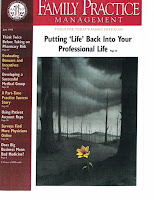
This journal cover was designed to accompany one of two cover articles the Dr. John-Henry Pfifferling and I coauthored in the late 1990s about burn-out and compassion fatigue, a concern that we encountered with physicians we met in our work together at the Center for Professional Well-being. In the cover article, John-Henry and I said that it took six months to recover from long-term burnout. We knew, and more importantly I knew, that there were no short-cuts. I desperately needed that six months to recover.
I assured my boss that I would put in the five months that I expected it would take to complete open projects and leave my clients in a good place, but I just couldn't do it any more. I explained that this picture reflected how I felt after giving too much for too long. I needed time to nurture the little ray of color left in my life.
Yet, even though I knew it would take six months, when the end of my extended notice arrived, I immediately took another job. I gave myself many reasons why I was ready to go to a different job. They were all lies that I told myself because it was a good opportunity. I knew I needed the time to heal. A few months later when I finally admitted that I needed the time, it was an admission of something I'd known all along: I needed to heal.
In some recent posts, I've bragged that I'd knocked a lot off of my "to-do list," lamented that I hadn't discovered my new purpose, and complained that I had a hard time hitting the ground running like I used to. These are all signs that I haven't been adequately healing from my burn-out. As I crawled into bed last night after yesterday's post, the image of this journal cover occurred to me. About the same time, I recalled that today would be Ash Wednesday, which marks the beginning of the 40-day Lenten season, a time of intense spiritual reflection and fasting leading up to Easter.
Although the 40-day Lenten season coincides with the 40 days that Jesus spent praying and fasting just before his crucifixion, that number is probably not happenstance. Since almost the beginning of time, 40 has been a spiritual number which symbolizes "time needed to totally recharge, renew the body; change to a higher perception."* Moses was on Mt. Sinai for 40 days before returning with the Ten Commandments, and he led the Israelites for 40 years before he acknowledged that they had the understanding of God that they needed. Rain fell on the earth for 40 days and nights, creating the flood from which Noah saved the animals in his ark. It occurred to me that the seven weeks of vacation that I had accrued and was going to use to "cover" my recovery was just a hair over the 40 days.
Since I had really given myself less than a week to recover from burnout before charging into a new class and book and cupboard cleaning, I think I need a restart, and what better time than this designated period of Lenten reflection? I didn't worry about when I woke up this morning. I went to church. I spent the afternoon reading a book I wanted to read and plan to go back to it when I finish here. I didn't even turn my computer on until almost 10 tonight, and that was to write this blogpost. (I did make one quick email check on my iPhone on the way to church this morning, and then I closed the mail app.) I turned the news on this morning, and just as quickly turned it off. I spent time in the kitchen, trying a new recipe.
I don't know what this 40 days will bring. I think that is the point. I am going to make every effort to stay out of my head, avoiding all but the very essentials of anything that smacks of planning and productivity. My 40 days will not be the six months that I know I need to heal from burn-out, but, with God's help, at the end of the 40 days, I will know what I need to do next. I think that is all I need to do. Be as present as I can be and allow myself to be led. Ah, that quintessential spiritual lesson...again!
*Bethards, Betty, The Dream Book--Symbols for Self-Understanding, Element, 1983, 1995, P. 140.
Tuesday, February 28, 2017
What Gets Me Up in the Morning?
I've been writing about thoughts I've had while reading Blue Zones--9 Lessons for Living Longer from the people who've lived the longest. The last of the characteristics which centenarians in "blue zones"--those regions that have a disproportionate number of individuals who live to be over 100--shared across the globe was a "sense of purpose." I particularly liked the Okinawan's embrace of "ikigai"--the reason they get up in the morning.
While I've always felt like we have a reason that we are in the world, and I've also thought that it evolves over our lives, I've generally had the mental model of life purpose as a major contribution to the world. However, in the blue zones the reason that gets people up in the morning is a focus of activity that individuals take with them through life. For one, it is maintaining his ability to do certain physical exercises. For another, it is hiking to the top of a ridge he has scaled every day for 80 years to see the spectacular view. For still another, it is caring for her grandchildren, great-grandchildren, and sheer delight in holding her first great-great-grandchild.
Whatever it is for each of these, it is something that gets them out of bed in the morning.
I've actually been struggling with getting up in the morning during my transition period. Not in a depressed way. After a lifetime of bouncing up and hitting the day running, as the old commercial used to say, "My get-up-and-go got up and went." I have shifted to a night-owl schedule which is more natural to me. And, I really wanted not to have to b aroused by an alarm ever again. I used to wake after 7-1/2 or 8 hours of sleep, even without the alarm, so why should I need it? At first, when I slept long, I thought it was years of exhaustion accumulated and demanding rest.
Once I am up and moving, I can focus from activity to activity, and I get a reasonable amount accomplished. I've been ticking things off my to-do list, and I am pleased to say that a long Outlook task list was completed today. I've taken a number of webinars and am reading several books in parallel. When I start moving, I have plenty of focus and energy.
It's just getting started. About a week ago, I even started setting the alarm again, but except on the day when I had to report for surgery, I've shut it off and gone back to sleep. Then I read about ikigai. While I have lots to keep me busy once I am awake, I don't feel like I have a reason that compels me to get up in the morning. In large part, that is what this transition is about--finding that new purpose. But perhaps I've been aiming too high. Maybe my purpose could be as simple as living the best life to carry me to 100 or writing in this blog every day, even though there are many days when no one reads it.
What, I've been asking myself, will make me want to bound from bed the way serving my clients did when I had a regular job? (And when that was gone, it told me that it was time to find something different to focus on in my life.) I'm not there yet, but having the question will allow me to play around with some options when the alarm goes off in the morning.
Monday, February 27, 2017
Who's in Charge?
I finished reading Blue Zones--9 Lessons for Living Longer from the people who've lived the longest last night. It has left me pondering two questions. I will explore one today, and I'll save the other for tomorrow's post. I'd like to start with "locus of control." The textbook that I used to teach organizational behavior defines "locus of control" as "the degree to which people believe they are masters of their own fate."*
What the textbook says, and what I taught, is that if a person believes their success is internally driven, called "internal," they are more highly motivated and willing to take action to make things happen in their lives. They generally perform better on the job, demonstrating their belief that they are the ones that influence career success. Internals believe their health is largely in their hands, and they take steps to stay healthy. Consequently, they have lower rates of absenteeism.
By contrast, "externals" believe that some force outside of themselves determines their fate. In that case, they are not inclined to take steps to advance their careers or their lives. Why would they, since they don't believe that anything they do, for good or not, can change the course of their lives? They generally aren't engaged in their work and are less satisfied in their career and life in general.
Many externals believe that God or some other outside force is piloting the ship of their destiny, but many internals attribute God's desire for us to experience abundance to the reason they are in charge of their destiny. Prosperity gospel churches and Mastermind groups are examples of the latter group.
The uncomfortable juxtaposition of these ideas has been on my heart for decades. I am all about intention, which might lean to internal locus of control, but I clearly believe that God steers us, uses us as vessels to accomplish work, and stops us when we go astray. Many years ago I came to believe that God would guide us but we had the responsibility to execute The Plan. Furthermore, if we have spiritual lessons to learn, God won't intervene without being asked, forcing us to grapple with whatever lesson is at hand. In Choice Point, I wrote about this as the dance we do with God: God leads, we follow but we have to know how to do our part.
Now, you may ask, what does all this locus of control talk have to do with Blue Zones and living longer. It ends up that people to live to be 100 and beyond demonstrate the dichotomy with which I've wrestled. Most centenarians do have faith that something beyond themselves is steering them through life. But, contrary to what behavioral researchers have found in workplaces, those who live long are happy, they find joy in life, and they laugh off things that don't go as they might have liked--even in situations as trying as the death of a child. "There's a bigger plan," is what most would say. "Don't worry." And, clearly, the external orientation of their destiny has not had negative impact on their health.
Stress and worry are detrimental to our health. Those "externals," who just let go of things, rid their bodies of cortisol, the stress hormone which has significant deleterious impact on our bodies. Wherever Buettner and his team found high concentrations of people who live to 100 and beyond, Bob Marley's lyrics, "Don't worry. Be happy," echo prominently, but joyfully.
Once again I find myself in a gray zone, wishing to ask, "Is it internal?" or "Is it external?" Instead I am going to integrate the several lessons. While behavioral researchers have found that externals are less satisfied with their lives, it is because of a sense of resignation that whatever is controlling their lives has decided, "This is as good as it gets." Conversely, the centenarians who believe an external force controls their lives believe that it is a force for good which is watching out for them. "Things are going to be better; I just don't understand how." Rather than the source of control, I think satisfaction of life lies in a deep-seated optimism that whatever is going on--good or bad--it is destined to be better.
*Stephen P. Robbins, Organizational Behavior, Prentice Hall, 2005, Glindex, P. 642.
Saturday, February 25, 2017
Health, Happiness, Wholeness
I had minor surgery a couple of days ago and after a day of pretty much sleeping it off, I've been up to my ears in exploration--watching videos on YouTube and reading. Spiritual teacher Caroline Myss has said that when we find what we believe to be a spiritual truth, we should seek to find it elsewhere. She generally has in mind other religious traditions: Myss says key truths of most religions can be found in some manidestation in others, often several others.
My frame of reference for spirituality extends beyond religion, but with that said, I believe that when we find what we believe to be truth anywhere in the world, we will find it multiple places. As those who have been reading recently know, I've just finished my certification as a health coach, and this little post-surgery respite has given me the opportunity to start reading the stack of health-related books that have accumulated by my desk over several years. There's at least 80 per cent congruence (maybe more) between the content in all of them, and yet each brings a different nuance or something new.
What has continued to astound me has been the intersection between health and happiness. It doesn't surprise me at all that we are happier when we are healthier, but it seems to me that the things that we do to be healthier are the same things that we do to be happier. The causality may not be between health and happiness, but rather between a set of behaviors that cause us to be both healthier and happier.
My old friend "laughter" shows up a lot. Today I've been reading Blue Zones--9 Lessons for Living Longer from the people who've lived the longest, by Dan Buettner. The book is based on research he did for National Geographic on regions of the world where a disproportionate percentage of the population lives past 100. There's even a subset of the "blue zones": semi-supercentenarians--referring to regions with a disproportionate percentage of the population over 110. As he did his research, Buettner and his team traveled to often-remote regions to interview those over 100. I was struck by how often the centenarians burst out in laughter.
Laughter is a characteristic of both health and happiness. A couple of years ago when completing my certification to be a laughter yoga teacher, we were given a full page of benefits of laughter, most of them were health enhancements. For instance, one minute of laughter has the aerobic impact of 10 minutes on a rowing machine.
Dr. Martin Seligman, father of positive psychology/psychology of happiness, has said that lack of laughter is a challenge to the happiness of those who live alone because they don't laugh enough.
Spiritually, laughter is often observed in those who are truly "light." If you've ever watched a video or interview of His Holiness the Dalai Lama, you know that he often bursts out in contagious belly laughter.
It has been said that the road to Hell is paved by good intentions. When I set out to live my life with intention and to share my journey with others, it was specifically so that my life's intentions would not be squandered. My intentions are to have a life of health, happiness, and wholeness that will grow me spiritually.
Yet, despite knowing the benefits of laughter to health, happiness, and my spirit and my pathetic moaning and groaning about lack of laughter in my life, at least 18 months after completing my Laughter Yoga certification, I have yet to teach a single class. As I've been leaning into my transition, teaching Laughter Yoga (LY) must be part of my health coaching practice. Laughter is clearly a component of both health and happiness; it would seem it would be neglectful of me to omit it. I've just drug out my LY textbook, and I am throwing it into this soup I am making called "My Life as a Health Coach."
Tuesday, February 21, 2017
Synthesis
"When the student is ready, the teacher will appear." This much-quoted thought is most often credited to Buddha Siddhartha Gautama Shakyamuni, or to many of us, just "The Buddha."
I'd like to alter the line just a bit. "When the student is ready, the teacher will appear...and appear...and appear." So often, it seems that when I start working on a spiritual lesson, everywhere I turn I bump into a slightly nuanced version of the same lesson. Like a fine crystal, every way I turn it, I see unique impressions which describes a nuance of the lesson.
The last two evenings I've written about slightly different versions of seeing lessons through a lens of letting them support me in experiencing the beauty and wonder of spiritual growth as an endpoint but through which I must tiptoe through lessons. Today brought two very distinct, yet remarkably similar extensions of those lessons, or "teachers," if you prefer.
"People's Pharmacy" is one of my favorite sources of well-researched health information, and I've been a faithful listener for over 25 years (and an avid reader of their newspaper column for years before that.) When I moved to DC, I could no longer get the show. Since discovering the podcast about a month ago, I've been devouring many back episodes. As consequence, I am not sure when ones to which I listened today aired. The show's guest was Matthew Sanford, a yoga instructor and paraplegic. He lost use of his body from the chest down when he was 13, if I recall correctly 38 years ago.+
Because I've had significant body function/pain issues over the last 25 years, I listened carefully as he described the change he had experienced in his relationship with his body. (You might say he was rewriting his story.) His rehabilitation programs taught him how to overcome his disability by using parts of his body that were able to do so to facilitate movement through the world. But, Matthew missed his body and didn't like the image of dragging non-functioning parts of his body through the world. (My words, not his.) He began doing yoga to assist his experience of how his mind and body connected: his body is his body to be experienced not overcome.
As I listened, I drifted to the years I spent in rehab. At first, I wanted someone to make it better, and I spent years just doing with determination whatever I needed to "get back to normal." As soon as I'd experience a modicum of time with minimal pain, I'd stop doing my exercises, and soon I'd be in pain again. Ten or 12 years ago...maybe more...I had an aha! moment when I realized that if I was going to live with a minimal amount of pain, my physical therapy exercises were going to be an everyday part of life. I wouldn't like it but I would commit to doing them, day in and day out. It was a good decision. Although I do fall into periods of pain from time to time, if I faithfully do my exercises, most of the time I am relatively pain free.
I was doing a light jog on the treadmill as I was listening to the interview with Matthew. Mirrors all around me showed that I was in pretty good shape. A personal trainer who had worked with me last week had pronounced my routine as pretty thorough and had little to suggest that I add. I was able to walk 65 minutes on a springlike day yesterday.
As I listened to Matthew talk about the change in his thinking about his body, I realized that, perhaps less consciously than Matthew, I too had changed. I've moved beyond having to do exercises every day to stay out of pain to being delighted with this machine which is carrying me through life so effectively. If I were able to stop the exercises without pain, I wouldn't want to do that now. That is how I've come to show my body love...as it is.
Less than an hour later, I bumped into another teacher: an article by Dr. Tim Lomas, Ph.D., in Psychology Today.* He wrote about the approaching 20th anniversary of the positive psychology movement, launched by Dr. Martin Seligman. The piece was both retrospective and prospective, attempting to point the way forward for the growing psychology of happiness movement. The article described three stages: thesis, antithesis, and synthesis. For the first part of its history, psychology had been concerned with how to get us out of misery--the "thesis."
Then along came Seligman with the antithesis: the point of psychology should be to have us experience well-being and happiness. In so doing, all the miserable parts of our lives were castigated or discounted as negative or lacking in value. But, the article proclaimed, there is usefulness from fear: it allows us to assess risk. Lomas continues that "'anti-social' emotions like anger can impel one to resist injustice, and drive progressive social change."*
Finally, Lomas predicts the future of psychology as being a synthesis that values the downsides while supporting our individual quests for well-being. As he described this integration of resistance of the negative while supporting happiness and well-being, it seemed to me that what he was describing for our psyches was a parallel to what Matthew and I had come to in our relationship with our bodies and what I've been coming to over the last two days in this blog. There is value in the struggle with the parts of ourselves that we might not like, but as we learn to accept the richness of the whole, we enable our souls to reach their potentials.
This is not a new concept to me. In fact, I wrote about it in Leading from the Heart, which is also marking its 20th anniversary. I actually looked through the book this evening to get my exact quote, but I was unable to locate it; the gist is that we see the world in black and white when in truth it is a million shades of gray. (That was when shades of gray weren't X-rated.) When we only focus on what we perceive as bad--disability or misery--or good--overcoming and happiness, we lose the texture of the fullness of our existence. Wholeness lies in the synthesis--accepting the fullness of our possibilities.
+https://www.peoplespharmacy.com/2017/01/19/show-1065-how-can-yoga-benefit-everyone-fit-and-flexible-or-not/
*https://www.psychologytoday.com/blog/finding-light-in-the-darkness/201602/second-wave-positive-psychology-introduction
Monday, February 20, 2017
Rewriting Our Stories
For a long time, I've worked with coaching clients to "rewrite their stories." This language is certainly not unique to me and my coaching clients or even my own personal work. The idea is that whatever we've told ourselves about what is possible is a made-up story, so we can make up a different one...and then step into the one we prefer.
I didn't start dancing until I had literally hardly survived a personal health crisis. If I lived, there was a high likelihood that I would be a quadriplegic. I had always wanted to dance, but initially my mother didn't want me to dance and later circumstances always seemed to intervene. (Excuses.) When faced with the possibility that I might never walk again, I knew that the one thing I really wished I had done was dance.
By the grace of God and the hands of a remarkable surgeon, I am both alive and mobile, a fact that goes in my gratitude journal every day. As soon as I was finished with rehab, I went out and signed up for dance lessons. The rest is history. Thankfully, last night I danced almost every dance for three hours straight. Nothing makes me feel more alive or brings me more joy.
But, when I was learning something many learn in childhood or early adulthood, shall we say at a much later stage in life, I struggled. It felt to me like I took the same dance lesson over and over again. I was clumsy and certainly not the vision of grace that I dreamed of being. One day I heard that our brain needs to hear something 10,000 times before it believes it. Well, I thought, if that is my only problem, I will just start saying, "I am a dancer," until I've said it 10,000 times. Doing so became the soundtrack of my life. While I was driving in the car, while I was running, while I was swimming, and while I was bathing: "I am a dancer."
I said it different ways:
- I am a dancer
- I am a dancer
- I am a dancer
Then I added pizzazz, spinning about with my arms wide to the heavens: I am a dancer. One day it finally happened: in a split-second in the middle of a lesson I'd repeated over and again, the figure happened easily. Then I couldn't imagine how I hadn't been able to do it. By force of will, I had convinced my brain that I was a dancer, and now, humbly speaking, I am a pretty darned good one. I don't know if I said it exactly 10,000 times, but it must have been close. (I am sure that I hadn't put in the 10,000 hours that some people say is necessary for mastery.)
Today I was listening to a podcast interview with Bessel van der Kolk, M.D., the founder and medical director at the Trauma Center of Boston and a professor of psychiatry at Boston University medical School. He first worked with Holocaust survivors. More recently, he has worked with Iraqi and Afghan veterans and 9/11 and Boston Marathon survivors. He described one of the essentials in transforming a person's trauma experience is the ability to visualize a different ending. That prevents the individual from fearing a repeat experience.
He shared a story of a five-year-old who attended the childcare center at the Twin Towers and actually saw the planes fly into the skyscrapers. When van der Kolk had the boy draw a picture, as you might expect, it included the tall buildings with planes flying into them, and it also included a trampoline in the foreground. When van der Kolk asked about the trampoline, the boy said that was so people jumping from the towers would bounce with they landed. That boy experienced few traumatic after-effects that those who hadn't found an alternative resolution for the crisis did.
As I listened, I realized that what he had done was the same thing that I had done, as well as what my clients had done: the boy had rewritten the story. The scenario changed from people dive to their deaths to something vaguely resembling a game that most kids would enjoy: jump on the trampoline and dismount so the next person can use it.
Yesterday's blogpost about being hypercritical was fresh in my brain as I listened to this interview. What occurred to me was that in my shift from viewing spiritual lessons as drudgery to slog through, I had rewritten my story, visualizing a different ending this time. The slogging is now a passage way to something I want in my future. It seems to me that what works in goal setting for coaching clients and survival tactics for trauma survivors is also a good tactic for making our way successfully through our spiritual work. Visualizing what it will be like on the other side of the lesson and writing that ending for our story seems to be the key.
Yesterday's blogpost about being hypercritical was fresh in my brain as I listened to this interview. What occurred to me was that in my shift from viewing spiritual lessons as drudgery to slog through, I had rewritten my story, visualizing a different ending this time. The slogging is now a passage way to something I want in my future. It seems to me that what works in goal setting for coaching clients and survival tactics for trauma survivors is also a good tactic for making our way successfully through our spiritual work. Visualizing what it will be like on the other side of the lesson and writing that ending for our story seems to be the key.
Subscribe to:
Posts (Atom)